---
title: "Online Property Valuation vs Physical Appraisal: Which Fits Your Case?"
description: "Compare online, model-based, hybrid and physical property valuations in the Netherlands, including lender acceptance, reliability, limits and costs."
url: "https://bestetaxateur.com/en/guides/online-property-valuation-vs-physical-appraisal/"
locale: "en"
author: "Lucas Smit"
publishedDate: "2026-08-29T00:00:00.000Z"
updatedDate: "2026-09-08T00:00:00.000Z"
categories: "Property valuation basics, Mortgage valuation"
tags: "online valuation, hybrid valuation, physical appraisal, mortgage, property valuation"
---
# Online Property Valuation vs Physical Appraisal: Which Fits Your Case?
Compare online, model-based, hybrid and physical property valuations in the Netherlands, including lender acceptance, reliability, limits and costs.
## When this valuation matters
If you are choosing between online, hybrid and physical valuation, match the method to the recipient’s requirements and the property’s evidence. Buyers, homeowners, lenders and advisers can choose a method that the recipient accepts and that suits the property evidence.
## TL;DR
Ask the report recipient which method is accepted before comparing speed or price. An online estimate may help with orientation, while a hybrid or physical valuation can carry different checks, limits and mortgage conditions.
For a Dutch mortgage, ask for the accepted method before you order. NHG allows approved hybrid products in selected cases, while its 2026-1 conditions still require a physical valuation in situations such as financing above 90% of market value, determining value after improvements, some leasehold changes, certain forced-sale risks and auction purchases. An online estimate can help you orientate, but it is not automatically mortgage evidence.
With the situation clear, start by separating the property facts from the decision the report must support.
## Start with the purpose, not the label
The same phrase can describe different products. Before comparing speed or price, write down:
- who will receive the result;
- what decision it must support;
- which value date is needed;
- whether the home, loan or planned work is unusual;
- whether the recipient requires registration, validation or a particular report format.
This is the main distinction between a useful orientation figure and a document that a lender can use. [Valuation report requirements](/en/valuation-report/) keep purpose and intended use in the assignment, while mortgage valuation report requirements identify common financing triggers.
If you already have a report, [valuation report validity](/en/guides/how-long-is-a-property-valuation-report-valid/) determines which dates and recipient conditions matter before another method is ordered.
These are the details worth checking before you compare providers or send the file.
## Four products sold as online valuation
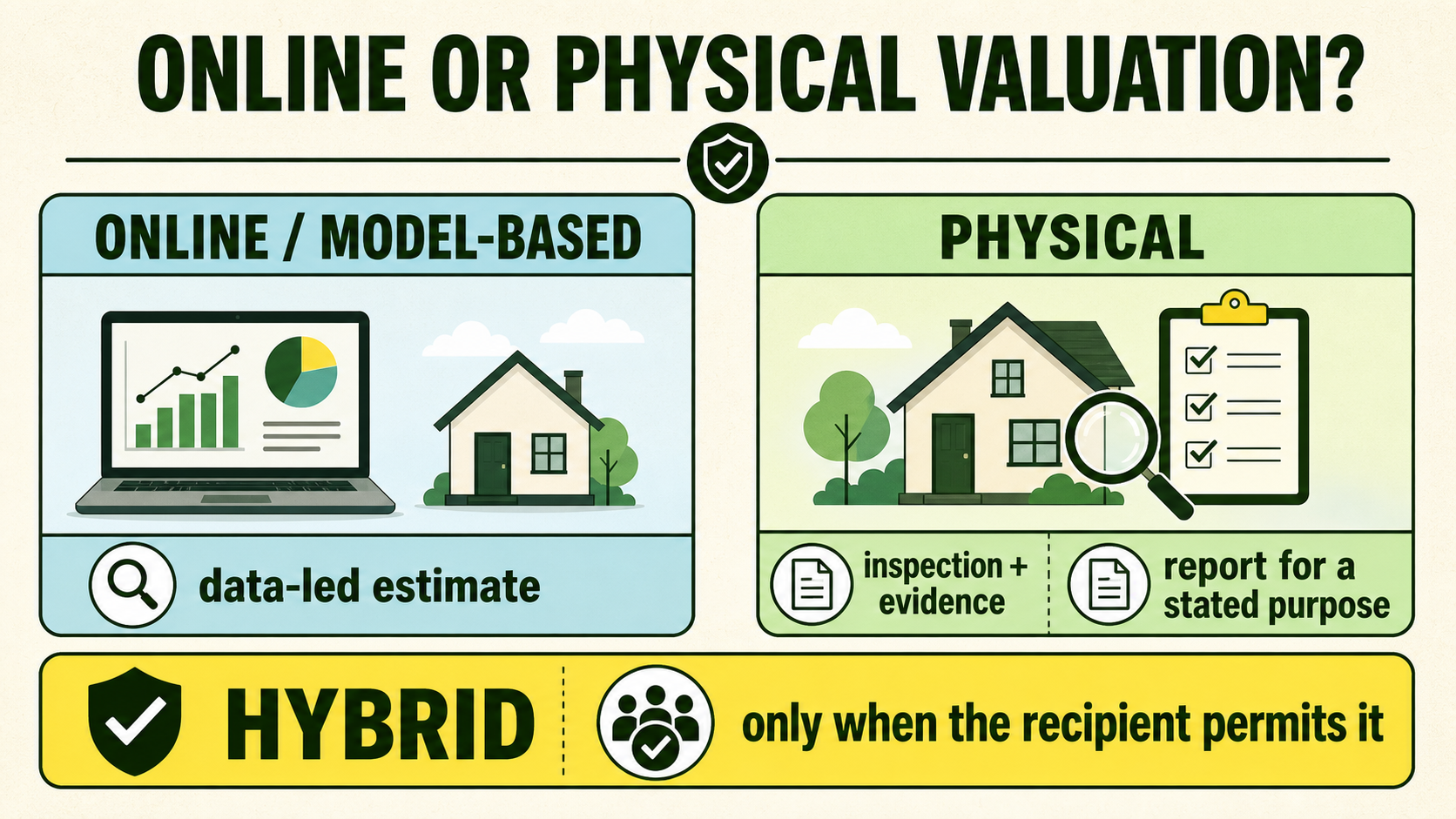
Informal online estimate
A calculator or portal produces an indication from entered property details and available data. It can help with orientation. A provider and recipient must expressly treat it as a professional appraisal before it can serve that role.
Model-based desktop product
A statistical model estimates value without a normal on-site inspection. The result depends on the model, the data coverage and the home's similarity to the reference properties.
Hybrid valuation
A model generates a value and a registered appraiser assesses the result for a defined financing purpose. NRVT's current FAQ says this is the Dutch term used after Bureauwaardering was replaced on 1 January 2025. A hybrid assessment is not the same as a full physical inspection.
Physical appraisal
An appraiser inspects the property and combines observations, documents, rights, characteristics and market evidence in a reasoned report. The recipient can still impose its own acceptance conditions.
The method is only one part of the product. Check who signs the result, who may rely on it, what it covers and what it excludes.
## What a physical appraisal adds
An inspection lets the appraiser observe matters that are difficult to infer from a database. Examples include layout, maintenance, finish, apparent alterations, access, surroundings and visible evidence of planned work. Documents still matter. An inspection does not turn an incomplete file into a complete one.
Your report should connect evidence to a value conclusion and state relevant assumptions and limitations. A physical valuation involves more than a house visit: it has a purpose, a value date, a report recipient and a defined scope.
That does not make physical appraisal infallible. The appraiser still selects and weighs market evidence, and a hidden defect may require a technical inspection. The method reduces some data and comparability risks; it does not remove uncertainty.
When you compare online and physical valuation, weigh [residential evidence from Duizel](https://taxatieeindhoven.com/property-valuation-duizel/) against the location and property facts required for a physical assessment.
## How reliable is an online or hybrid valuation?
Reliability is a fit question. A model can work well for a standard home in a data-rich area and be less informative for a property with a rare layout, major renovation, unusual rights, limited transactions or a material condition issue. A registered appraiser's review adds professional judgement, yet the hybrid method still has a different scope from a physical inspection.
Rabobank describes one Calcasa Desktop Taxatie method as using the **25 most recently sold similar homes** in the local area and adjusting for characteristics. The number belongs to that product description. The number describes that product; accuracy and the availability of 25 comparable sales need separate checks.
NRVT's [Reglement Hybride waardering](https://www.nrvt.nl/voor-register-taxateurs/regelgeving/reglement-hybride-waardering/6) requires the report to distinguish the model supplier from the appraiser and to explain purpose, intended users, limitations and the appraiser's reasoning. Those details are useful reliability checks. Look for them in the product information instead of treating the word “online” as a quality grade.
## The 90% NHG boundary in context
NHG's 2026-1 conditions give a concrete example of why method choice depends on the case. In selected hybrid situations, financing may be limited to 90% of market value. A physical valuation is required when the relevant case falls outside the hybrid conditions, including several situations listed in the NHG rules.
**Number:** 90% loan-to-value. **Context:** selected NHG mortgage cases using an approved hybrid product in the Netherlands under the 2026-1 conditions. **Comparison:** this is narrower than a rule for every lender, property or valuation purpose. **Explanation:** NHG uses the threshold as part of its acceptance conditions, not as a general measure of appraisal accuracy. **Implication:** confirm the method and maximum financing with the lender before relying on a hybrid result.
Illustrative arithmetic makes the boundary easier to see:
- loan amount: €360,000;
- market value: €400,000;
- LTV: €360,000 / €400,000 = 90%.
This calculation describes the ratio only. It does not calculate affordability, guarantee an NHG mortgage or say that a lender will approve the loan. Income, debts, product rules, purchase costs and the lender's file review remain separate.
Some NHG cases require a physical method or additional evidence, as set out in NHG valuation requirements.
## When a physical appraisal is the safer starting point
Ask the lender about a physical report first when:
1. the loan is more than 90% of the value in an NHG case;
2. the value after renovation, extension or energy work is needed;
3. the home has unusual construction, use, rights or leasehold arrangements;
4. the property is being bought at auction;
5. a forced-sale or residual-debt risk is part of the case;
6. the recipient explicitly asks for an inspected and validated report;
7. the available model result has weak comparables or missing property data.
NHG's conditions are the source for the listed NHG examples. A lender without NHG can use another policy. Property valuation documents identify the information an appraiser may need.
## When an online or hybrid product may fit
An online or hybrid method may fit when all of these are true:
- the lender confirms that the exact product is accepted;
- the purpose is within the product's permitted scope;
- the home is sufficiently standard for the model and has usable comparable data;
- the loan-to-value and improvement conditions fit the rules;
- the report recipient, value date and delivery deadline are clear;
- you understand what the appraiser did not inspect.
NRVT says hybrid valuation is for obtaining, refinancing or adjusting a mortgage or bank loan monitoring. Its FAQ excludes purposes such as inheritance, tax and division of an estate. Do not reuse a hybrid mortgage product for a different decision without checking the new recipient.
## Compare quotes by scope and cost
The lowest price is not automatically the lowest total cost. A quote can differ because it includes a visit, validation, extra research, a faster delivery date, a particular report format or work for a complex property. Ask each provider to state:
- the method and whether the property is inspected;
- the purpose and intended recipient;
- validation and registration requirements;
- what documents and follow-up questions are included;
- delivery date, report age and value date;
- taxes, extra visits and cancellation terms.
Like-for-like provider answers belong in comparing property valuers. An informal estimate may be free or inexpensive, yet ordering one first can add time if the lender later requires a different report.
## A decision check before you order
Send the lender or adviser one precise question: “For this property, loan purpose, expected LTV and value date, do you accept an informal estimate, a model-based product, an approved hybrid valuation or a physical validated report?”
Then ask for the answer in writing. If the property will change, mention the work and ask whether the lender needs a current value, a value after improvement or both. If you are comparing providers, confirm who signs the report and whether the report may be used by the intended recipient.
## Challenge the simple answer
“Physical is always better” is too broad. A physical report still relies on judgement and market data, and it may be unnecessary for a standard, low-LTV mortgage when the lender accepts an approved hybrid product. A physical report can also be unsuitable if it has the wrong purpose, recipient or value date.
“Online is always cheaper and faster” is also too broad. A model-based result may reduce inspection work, but a rejection, extra documentation request or replacement report can change the total time and cost. The accepted scope is the deciding constraint.
If cost, timing or acceptance still concern you, ask the provider to state each condition before the appointment.
## FAQ
### Is an online property estimate the same as an appraisal?
No. “Online valuation” can mean an informal estimate, a model-based product or a hybrid valuation. Check the provider, signer, purpose, intended user and acceptance conditions.
### Can a hybrid valuation replace a physical report for an NHG mortgage?
Sometimes, when the exact approved product and case meet NHG and lender conditions. NHG's 2026-1 rules list situations where a physical valuation is required. Ask the lender before ordering.
### Does a registered appraiser visit the home for a hybrid valuation?
Not in the same way as a physical appraisal. NRVT describes a hybrid valuation as a model value assessed by a registered appraiser at a distance. The product documents should state the scope.
### Is a physical report more accurate for every home?
Not automatically. It adds observations and professional judgement, yet value remains an opinion based on evidence and assumptions. Unusual homes and incomplete data can still require additional work.
### What should I do with a free online estimate?
Use it as orientation only until the decision-maker confirms that it is accepted. Do not present it as a lender-ready report without checking its purpose and conditions.