Market Value, Foreclosure Value and WOZ Value: What Is the Difference?
Separate market value, foreclosure value and WOZ value by purpose, date, assumptions and evidence, with current Dutch housing figures and a worked comparison.

When this valuation matters
If you are comparing property values, tie market value, WOZ value and forced-sale value to the question each one answers. Homeowners, buyers, taxpayers, lenders and advisers can keep market value, WOZ value and forced-sale value from being mixed in one discussion.
TL;DR
Market value, WOZ value and forced-sale value use different dates, purposes and assumptions. Identify the figure you need first, then compare its evidence with the decision or objection in front of you.
Dates explain many apparent differences. The WOZ value made available in 2026 uses 1 January 2025 as its value date. The Waarderingskamer reported a 10.6% national average increase between the 2025 and 2026 WOZ value dates. That movement describes a national average and does not turn a WOZ notice into a current mortgage valuation.
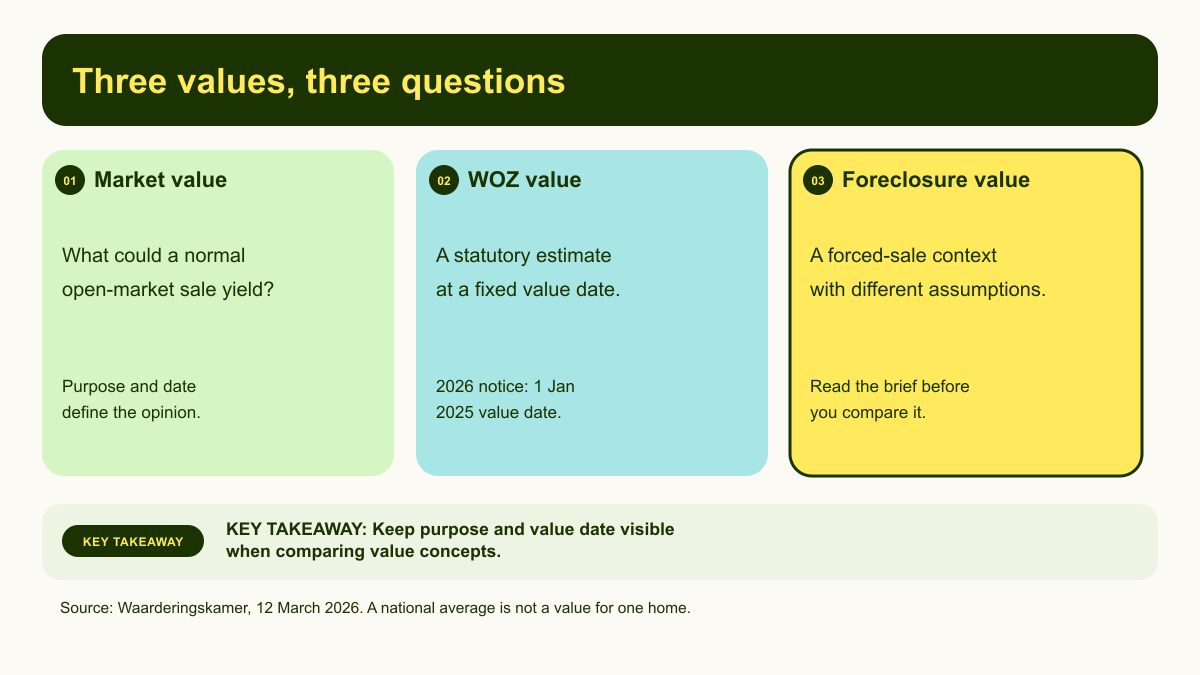
Keep that purpose in view as the details come in; each one matters because it changes what the appraiser needs to test.
When you compare market value, forced-sale value and WOZ value, place residential market evidence from Aalst beside the value date and scenario so you can identify which figure applies.
Market value
Market value is a reasoned value opinion for a defined situation. The assignment describes the property, rights, condition, market evidence, value date and assumptions. A valuer studies comparable sales and property characteristics before forming the opinion.
The Dutch housing market changes over time. CBS’s existing-home price index uses 2020 as 100. The national index was 149.5 for 2025, which is 49.5 index points above 2020. In the second quarter of 2026 it was 154.9, with a 4.2% change from the same quarter one year earlier. An index tracks a basket of existing homes and their price movement. It does not calculate the value of one address.
CBS also reported an average existing-home transaction price of €480,000 in 2025, nearly €29,000 above 2024. An average transaction amount combines different regions, sizes and property types. It is useful context for market movement and a poor substitute for a property-specific opinion.
The evidence behind a report starts with residential property valuation fundamentals, including property facts, condition and comparable transactions.
WOZ value
The WOZ value is produced under the Valuation of Immovable Property Act. The Waarderingskamer explains that it estimates the sale price a property would have achieved on the value date under the assumptions of the WOZ system. Municipalities use sales before and after the value date and account for the market-level change around that date.
The date is easy to miss:
- the WOZ notice made available in 2026 uses 1 January 2025 as the value date;
- the condition of the property is tied to the condition date, set to the same date here;
- a later renovation or market move is not automatically part of that historical estimate.
The Waarderingskamer’s March 2026 overview reports a 10.6% national average increase from value date 1 January 2024 to value date 1 January 2025. A simple calculation on a hypothetical €350,000 figure gives €350,000 × 1.106 = €387,100. This arithmetic shows how a percentage works. It only shows the arithmetic; the WOZ value for a home still depends on its municipality and property facts.
Foreclosure value
Foreclosure value relates to a sale under pressure, such as an enforcement or forced-sale setting. Time, access, marketing, occupancy, legal rights and the likely buyer pool can differ from an ordinary private sale. The report must state its assumptions so the reader knows what is being estimated.
Avoid a fixed “foreclosure discount”. The result depends on the property, market, process, rights and time available. A percentage copied from another case can create a false sense of precision. Ask which sale scenario, date and costs the report uses.
The next question is why this detail changes the valuation.
Why the same home can have different figures
Use this four-part comparison:
- Purpose: mortgage security, municipal taxation, normal sale or forced sale?
- Date: do both figures use the same market moment?
- Assumptions: vacant possession, use, condition, legal rights and sale exposure?
- Evidence: property-specific comparables, municipal model, market index or a pressured-sale scenario?
The more answers differ, the less useful a direct numerical comparison becomes. A number is meaningful only when valuation report requirements keep its purpose, date and assumptions visible.
Put the options beside each other first; the reasons behind the difference come next.
A worked comparison
Imagine a home with these figures:
- a 2026 WOZ notice based on 1 January 2025;
- a lender’s valuation dated in August 2026;
- a hypothetical foreclosure value based on a short sale period.
Even if the three numbers are close, they do not share the same date or purpose. A lender’s valuation can reflect August 2026 market evidence. The WOZ estimate looks back to January 2025. The foreclosure figure answers a different sale condition. The right question is “which figure does this decision require?” rather than “which number is the true one?”
How to read a value dispute
If a WOZ value seems wrong, collect the municipal decision, value date, property facts and comparable evidence before considering an objection. A lender’s report follows the lender’s instructions and can require a separate review. A sale negotiation uses yet another question.
Changes in energy performance, extensions, permits, leasehold or condition should be described with dates. Energy-label valuation keeps one property feature alongside location, floor area, type and age. For an inherited home, inheritance and estate-tax valuation separates a tax-value question from a market-value question.
With the purpose settled, you can work through the checks in an order that mirrors the decision.
Next steps
Write down the decision, recipient, value date and sale scenario. Then request the document that answers that question. When a mortgage is involved, ask the lender before ordering a report. When a WOZ decision is involved, use the municipal information and Waarderingskamer explanation. When a forced sale is involved, ask for the exact assumptions in writing.
If cost, timing or acceptance still concern you, ask the provider to state each condition before the appointment.
FAQ
Is WOZ value the same as market value?
The WOZ value is an estimate of market value under a statutory system and fixed value date. A private valuation can use a different date, purpose, evidence set and assumptions. The labels should not be treated as interchangeable.
Why is a WOZ value from 2026 based on 2025?
The value date is set at 1 January of the year before the tax year. The Waarderingskamer states that the WOZ value made available in 2026 uses 1 January 2025 as its value date.
Can I calculate foreclosure value as a fixed percentage of market value?
There is no safe universal percentage. The sale process, timing, occupancy, legal position and property demand affect the result. Read the assumptions of the specific report.
Market value, WOZ value and foreclosure value answer different questions. Check the purpose and value date before substituting one figure for another in a tax, sale or mortgage decision.
Ask about value terms →