Holiday Home Valuation: How to Prepare a Vacation Property Brief
A practical guide to valuing a holiday home in the Netherlands, with separate checks for use days, rental, location, rules and value date.

When this valuation matters
If you are valuing a holiday home, keep its property facts and use choices together. Buyers, owners, landlords and lenders need a value for a cottage, park home or other recreational property and want the report to reflect seasonality, rental rules and the way the home is actually used.
Provider fit depends on holiday-home appraiser selection alongside use, rental and rules evidence.
Table of contents
- TL;DR
- What a holiday-home appraiser does
- Why seasonal evidence changes the brief
- The five-part calendar and value-date check
- How to prepare the property file
- Common mistakes and edge cases
- FAQ
TL;DR
If you are buying, selling, refinancing or reviewing a holiday home, start by naming its use, location, season and rental setup. Those facts tell the appraiser which market evidence belongs in the report and which tax or operating questions need separate advice.
Tax rules are related but separate. Belastingdienst information says a Dutch second home is declared in box 3 using the WOZ value. Its 2026 actual-return page gives a worked own-use illustration of €237,000 x 5.06% x 243/365, or about €7,983. That is a tax calculation with defined inputs, not a market value, rental forecast or lender report.
That gives you a useful starting point. The next question is how the assignment works for the person who will rely on it.
For a holiday home near Eindhoven, compare residential market evidence from Meerhoven with the park rules, rental use and personal use before you set the valuation assumptions.
What a holiday-home appraiser does
An appraiser forms an opinion of value for a stated purpose, property interest and value date. Evidence may include the building, plot, location, condition, permitted use, comparable transactions, rental arrangements and market context.
A holiday property can be on a managed park, in a recreation area or outside the owner’s usual market. When income and rental strategy dominate, investment-property valuation needs actual rent, costs, occupancy rules and the property interest stated separately. Seasonal use and vacation-property rules add further context to the assignment.
The next question is why this detail changes the valuation.
Why seasonal evidence changes the brief
Use days and rental days are not interchangeable. A property may be available only in certain periods, subject to owner-use blocks, park management, maintenance closures or minimum-stay conditions. A headline annual rent without the calendar behind it is not enough to test an assumption.
Location evidence also needs care. A coastal cottage, forest lodge and city apartment can all be called a holiday property while serving different markets. The nearest permanent-home sale is not automatically the right comparable.
Some owners will reasonably say that a holiday home is still real estate, so ordinary property facts belong in the valuation too. Keep location, condition and physical features in view, then add use, rules and seasonality because those details change the relevant evidence. Residential property valuation provides the shared basis for location, condition and use.
With the purpose settled, you can work through the checks in an order that mirrors the decision.
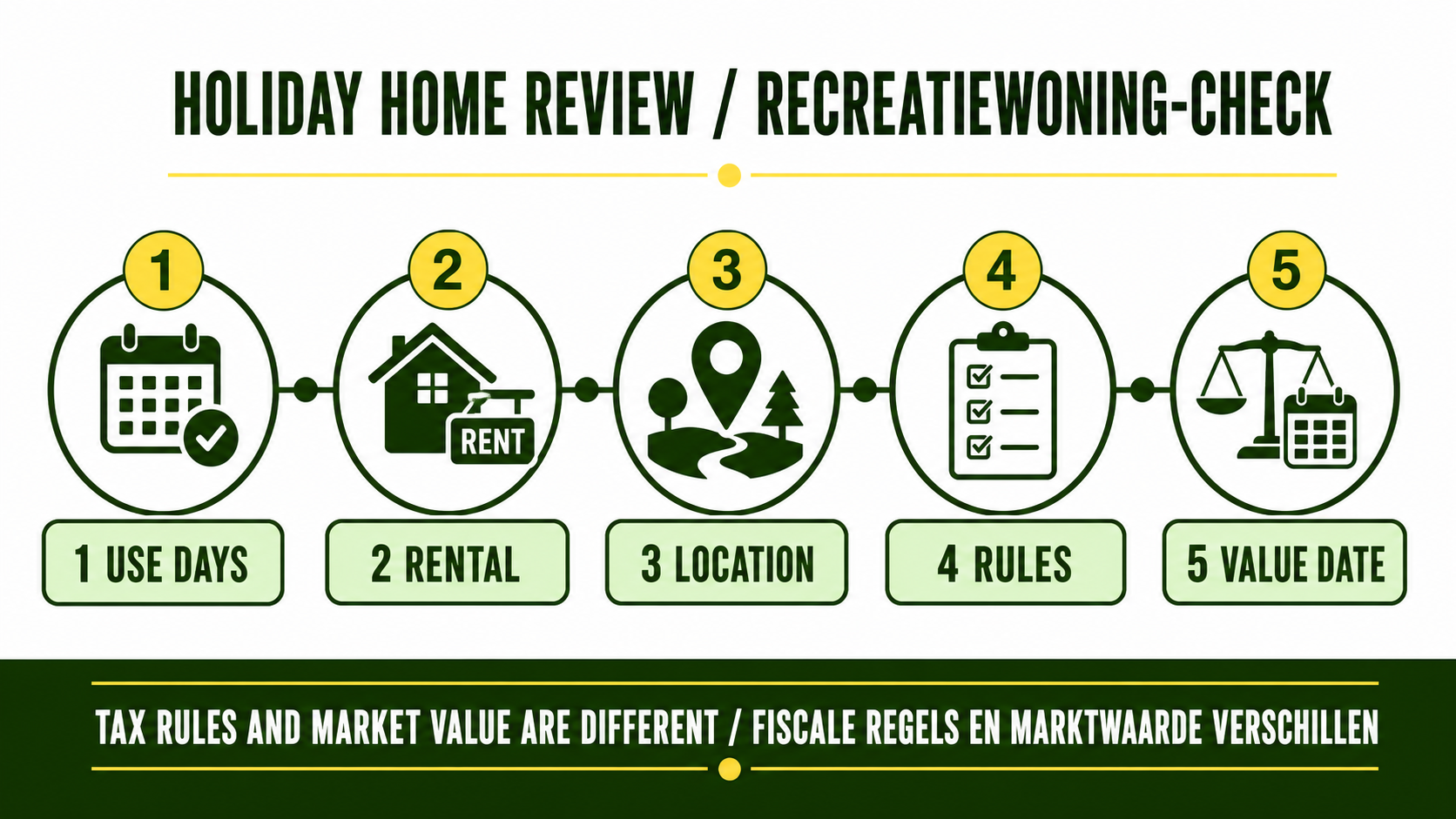
The five-part calendar and value-date check
1. Use days
Record owner use, blocked periods, maintenance closure, permitted occupancy and actual availability. Use a calendar for the relevant year rather than an annual guess.
2. Rental
Gather bookings, signed management agreements, realised rent, commission, cleaning, service charges, cancellation terms and vacancy. Separate actual results from a projection.
3. Location
Describe access, amenities, tourism demand, comparable parks or properties and the local market. Use comparables that share the relevant use and legal context.
4. Rules
Check park rules, permitted use, planning position, lease or land conditions and restrictions on letting. Ask the municipality, park manager or adviser to confirm legal meaning where needed.
5. Value date
Write down the date the valuation must answer. Tax value dates, market-value dates, inspection dates and lender age rules are not automatically the same.
Good preparation keeps a missing document from becoming a late surprise.
How to prepare the property file
- Name the purpose and recipient. A sale, refinance, purchase and tax question should not be merged.
- Identify the property interest. Include address, unit, plot, parking, storage, park or land rights.
- Make a use calendar. Mark owner use, rental, closure and unavailable days.
- Gather rental evidence. Include actual bookings and agreements as well as projections.
- Record rules and condition. Add park documents, permits, maintenance records and known defects.
- Review the report. Check method, comparables, value date, assumptions and uncertainty.
The file should identify the property, rights, use calendar and available records; property valuation documents help expose missing general facts. Valuation costs can vary with scope, access, travel and scope, so compare the work included.
Keep these points in view when you ask for the report.
Before you book, check the mistakes that can create extra work or leave you with the wrong report.
Common mistakes and edge cases
- Treating the WOZ figure as the current market value for every purpose.
- Using projected peak-season rent as if it were a full-year realised result.
- Ignoring owner-use days or a park’s blocked periods.
- Assuming a permanent residential comparable has the same permitted use.
- Forgetting service packages that can affect tax classification.
- Comparing a report with a different value date.
Foreign holiday homes, a park lease, a mixed-use property, an unusual management contract or a planned conversion should be flagged early. The right professional for a tax, legal or planning question may not be the appraiser.
Use these questions to test whether the proposed work fits your situation.
FAQ
Is a holiday home valued like a normal house?
Some physical evidence is shared, but use, location, rules, seasonality and rental evidence can change the relevant comparison. Your assignment should make those facts visible.
Does the Belastingdienst example give me the value?
No. The 2026 example is an actual-return tax illustration based on a WOZ value, percentage and usable days. It only illustrates a tax calculation; a market valuation answers a different question.
Can rental bookings prove the property’s value?
They can be relevant evidence, but occupancy, fees, restrictions, expenses, lease terms and market conditions also matter.
Can a lender accept a holiday-home report?
Acceptance depends on the lender, property, purpose and report requirements. Ask before ordering and name the recipient in the brief.
When should the report be updated?
When the use, rules, rental agreement, condition, market or required value date changes materially. Confirm the recipient’s age rule.
A holiday home is shaped by when it can be used, how it is rented, which rules apply and which date the report must answer. Gather the rental calendar, agreements, charges and restrictions before comparing a valuation with a tax figure or an asking price. Contact us with questions about preparing the brief.
Ask about holiday-home valuation →