Investment Property Valuation: What a Buy-to-Let Brief Should Include
Understand the evidence behind an investment-property valuation, from the asset and rent to use, financing context, tax boundaries and value date.

When this valuation matters
If you are valuing a buy-to-let property, keep leases, vacancy, owner use, operating choices and the building in view. Landlords, investors, lenders and buyers face this question when they need a property value and want rental income or a forecast to stay in its proper place.
If the property consists of rooms or shared rental units, student-room appraiser selection should address points-based rent evidence and shared facilities.
Table of contents
- TL;DR
- What an investment-property appraiser does
- Why valuation is not the same as a tax return or investment forecast
- The five-part investment-property check
- How to prepare the evidence
- Common mistakes and edge cases
- FAQ
TL;DR
For an investment property, describe the current use, leases, rent evidence, vacancy and valuation purpose before the appointment. The appraiser can connect income evidence to the property while keeping tax, financing forecasts and business decisions separate.
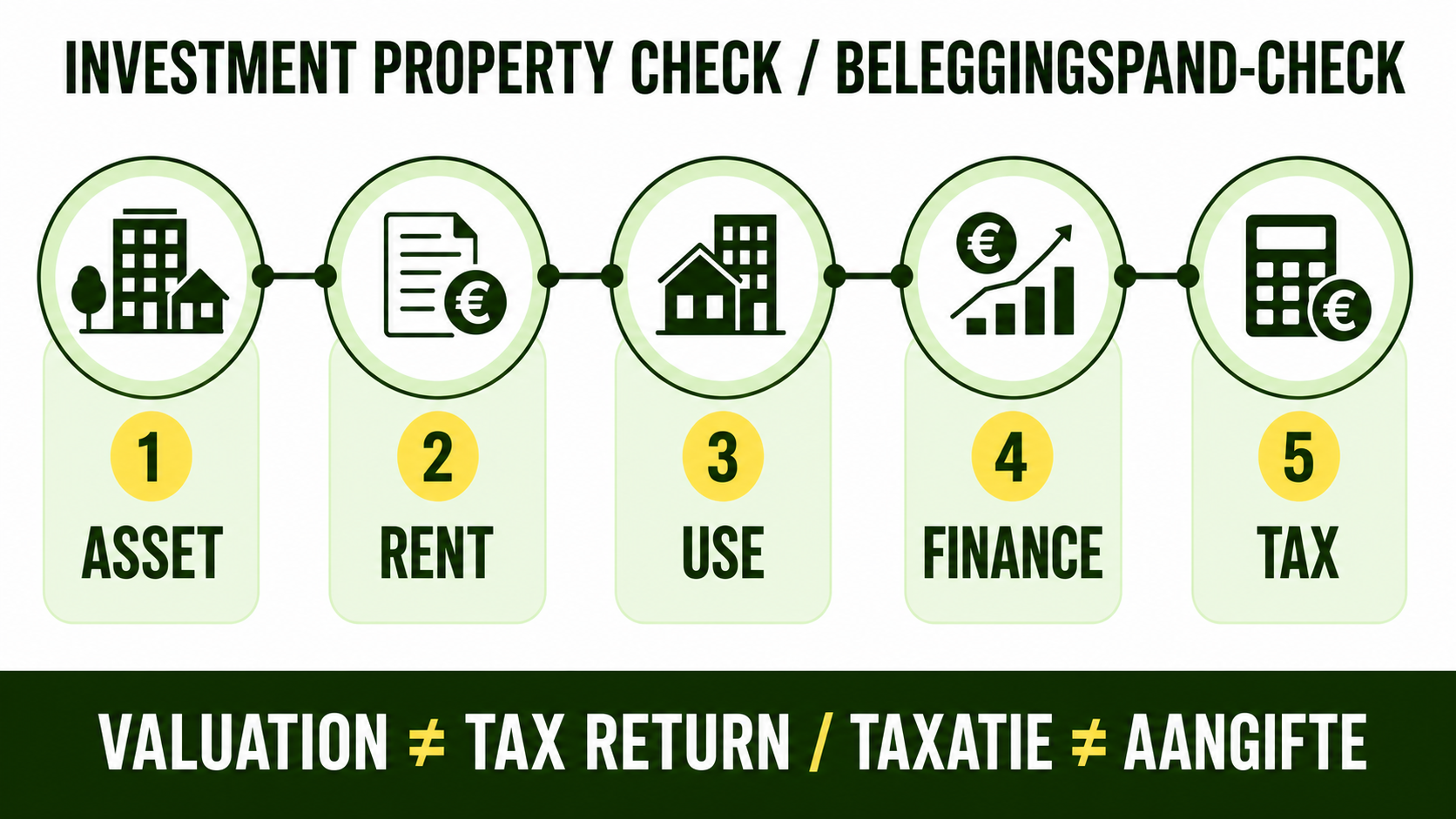
Use five checks: asset, rent, use, finance and tax. The first three are direct evidence about the property and its operation. Finance and tax are context for the decision and must not be smuggled into the value conclusion without an explicit assignment. Belastingdienst information about a second home is useful for tax orientation, but it does not replace a market valuation.
That gives you a useful starting point. The next question is how the assignment works for the person who will rely on it.
For a buy-to-let property near Eindhoven, separate residential market evidence from Wintelre from the rental-income analysis before you set the value assumptions.
What an investment-property appraiser does
An appraiser forms an opinion of value for a defined property interest, purpose and date. For a rental property, the evidence can include the physical asset, location, legal use, lease terms, rent, vacancy, condition, comparable transactions and market information. The method and depth of investigation depend on the assignment.
When the property is a shop, office, hospitality asset or mixed-use building, commercial property valuation makes the lease, income and operating evidence explicit. A buy-to-let apartment can be residential in form but still needs a clear rental and use brief.
Now the practical consequence becomes clear: the evidence has to answer the question behind the assignment.
Why valuation is not the same as a tax return or investment forecast
The Belastingdienst says a Dutch second home is declared in box 3 using the WOZ value, while a rented second home is treated as other real estate in box 3. It also explains that extra services around a holiday rental can affect tax classification. Those pages answer tax questions. They do not provide the market value for a lender, sale or division.
The actual-return page gives a useful illustration for 2026: using a €237,000 WOZ value, 5.06% and 243 usable days, the own-use calculation is €237,000 x 0.0506 x 243/365 = about €7,983. This is a tax calculation with defined inputs. It only illustrates a tax calculation; rental yield, future profit and property value require separate analysis.
An investor may reasonably focus on return rather than a number in isolation. Put that aim in the brief by saying whether the report supports acquisition, lending, reporting, sale or portfolio planning. The appraiser can then identify the relevant property evidence, while the investor keeps financing, tax, management and future-rent assumptions visible as assumptions.
With the purpose settled, you can work through the checks in an order that mirrors the decision.
The five-part investment-property check
1. Asset
Describe the property interest, unit, surface area, condition, ownership, rights and location. Include storage, parking, land, common areas and any separation between the rented unit and other assets.
2. Rent
Provide signed leases, amendments, deposits, indexation, rent arrears, incentives, service charges, vacancy and actual receipts. Distinguish contracted rent from an estimate of market rent.
3. Use
Record who occupies the property, permitted use, owner use, short-stay use, services and any restrictions. A property marketed for several uses should not be treated as if every use is equally lawful or achievable.
4. Finance
State whether the report is for purchase, refinance, loan monitoring or another decision. Keep loan amount, interest rate and desired loan-to-value in the decision brief, but do not treat them as evidence of the property’s value.
5. Tax
Write down which tax question is being asked and for which year. Use current official guidance or a tax adviser for that question. Do not ask a valuation report to silently determine your tax position.
Once those points are clear, gather the records that let the appraiser test them.
How to prepare the evidence
- Name the purpose and recipient. A lender, buyer, tax adviser and co-owner can need different outputs.
- Separate actual from projected income. Label each figure as contracted, received, market estimate or scenario.
- Collect property and lease facts. Add plans, permits, service-charge information, condition evidence and restrictions.
- Make use explicit. Note vacancy, owner use, short stays, services and any planned change.
- Ask which method fits. Request an explanation of the most material inputs and any sensitivity.
- Review the report. Check property identity, value date, assumptions, evidence, uncertainty and intended use.
The intended recipient determines valuation report requirements, including the purpose, evidence and format that the output must satisfy. If the assignment is a purchase or refinance, confirm the recipient’s acceptance requirements before ordering.
Keep these points in view when you ask for the report.
Before you book, check the mistakes that can create extra work or leave you with the wrong report.
Common mistakes and edge cases
- Calling an asking price or spreadsheet output a valuation.
- Using gross rent without checking vacancy, incentives, repairs and service charges.
- Treating owner use as rental income without stating the assumption.
- Mixing tax values such as WOZ with a current market-value question.
- Assuming a property can legally move from long-term rent to short stays.
- Ignoring a value date when rent, interest rates or regulation changed.
A vacant unit, a first-time landlord, a property with services or a mixed-use building can require different evidence. The right response is a sharper brief, not a more confident unsupported number.
Use these questions to test whether the proposed work fits your situation.
FAQ
Is a higher rent proof of a higher property value?
No. Rent can be important evidence, but lease length, vacancy, costs, condition, legal use and market evidence also matter.
Can the appraiser calculate my tax?
The report may record relevant property facts, but a tax calculation and tax advice are separate questions. Use current Belastingdienst information or a qualified tax adviser.
What is the difference between yield and value?
Yield is a relationship between income and price under stated assumptions. Value is an opinion for a defined purpose, date and interest. A yield input cannot be used without explaining the evidence behind it.
Can a mortgage lender use an investor’s spreadsheet?
That depends on the lender and report requirements. A spreadsheet can explain the decision context, but an accepted valuation report still depends on the lender and report requirements.
When should a buy-to-let property be rechecked?
When the purpose or value date changes, the lease or use changes, the property is renovated, or market evidence has moved materially. Ask the recipient whether an update or new report is required.
Before ordering an investment-property valuation, prepare the leases, actual rent, vacancy, use, condition and the purpose of the report. Keep your financing model and tax questions separate from the value opinion. Contact us if you want to check whether your evidence matches the question you need answered.
Ask about investment property valuation →