Appraiser for a Foreclosure or Forced Sale: What the Report Should Clarify
Learn how a valuation brief for a foreclosure or forced sale differs from an ordinary market-value question, and which facts, assumptions and recipients must be made explicit.

When this valuation matters
If you are dealing with a forced sale, define the requested value basis, date and sale conditions before you compare evidence. Owners, lenders, trustees, lawyers and buyers need to know which value basis is requested, which date applies and how sale conditions affect the evidence without confusing a market opinion with a sale result.
Table of contents
- TL;DR
- What a specialised appraiser does
- Why the value question must be separated from the sale pressure
- The five-part forced-sale review
- A controlled briefing process
- Common mistakes and edge cases
- FAQ
TL;DR
In a foreclosure or forced-sale case, state the sale conditions, value basis, date and intended reader at the start. The appraiser can then separate market value, forced-sale assumptions, property condition and the legal process that another adviser must handle.
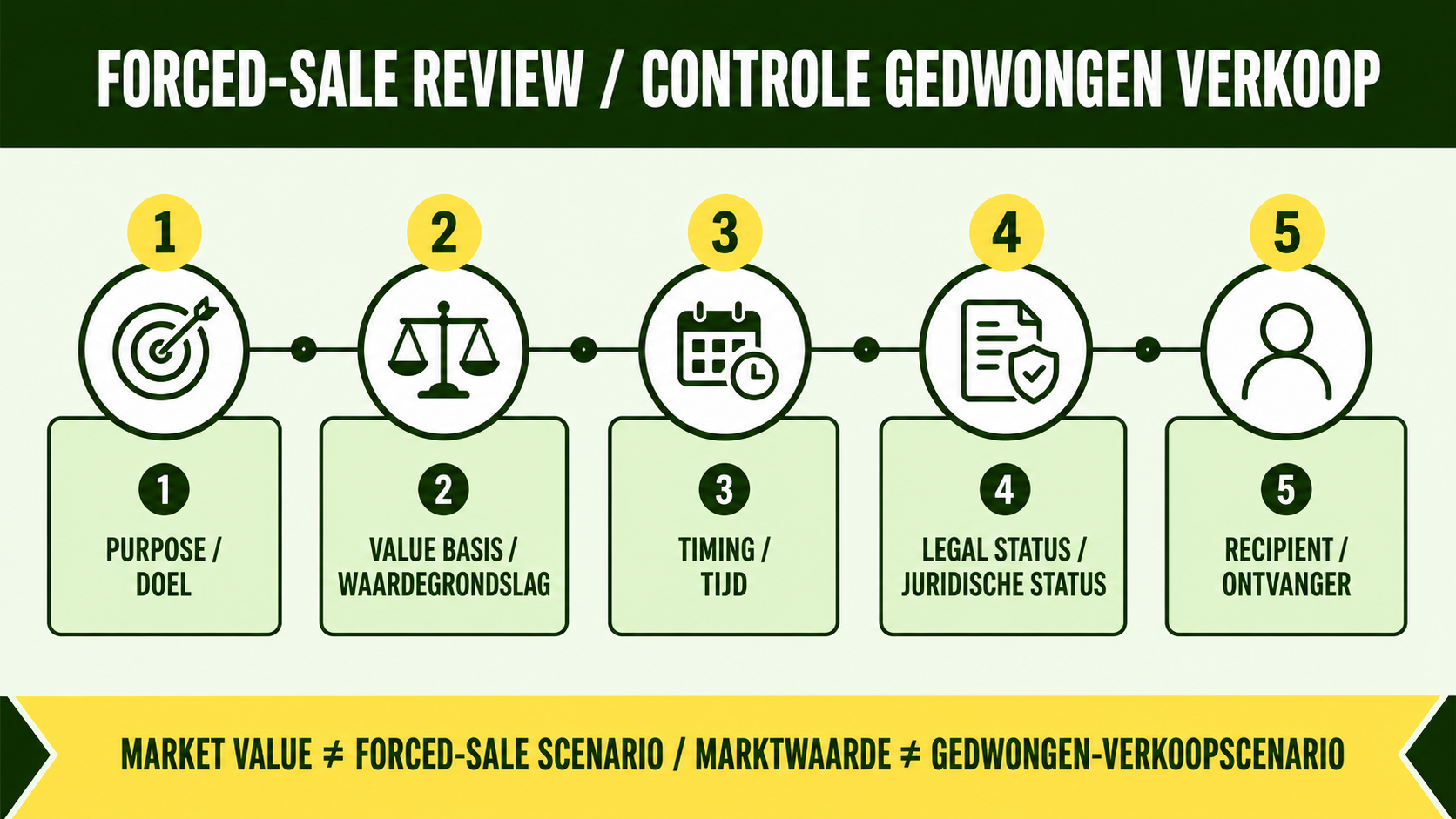
That distinction matters because an executorial sale is a legal and auction process, while a valuation is an evidence-based opinion for a defined assignment. Start with five checks: purpose, value basis, timing, legal status and recipient. Do not use an auction result as a simple percentage discount from market value without investigating the circumstances.
Once you name the decision, the rest of the valuation becomes easier to follow.
If you are assessing a forced-sale property near Eindhoven, compare residential market evidence from Stratum with the forced-sale assumptions before you state which value scenario applies.
What a specialised appraiser does
A property appraiser forms an opinion of value for a stated purpose and value date. In a pressured sale, the work may need more explicit assumptions about marketing time, inspection access, possession, tenancy, condition and the information available. The appraiser still needs to explain the evidence and the limits of the conclusion.
Kadaster describes an executorial sale as a public sale before an authorised notary when a debtor is in default. Its information about public-sale deeds shows that the legal file and auction record can contain useful facts about the process and proceeds. Those documents can support research, but they do not by themselves answer what the property would have sold for after ordinary marketing.
Because a forced-sale case can also involve ordinary market value or WOZ, market value, foreclosure value and WOZ value keeps the terms separate from legal advice, auction strategy and debt-priority questions.
The next question is why this detail changes the valuation.
Why the value question must be separated from the sale pressure
Market value assumes a defined market setting, willing parties, proper marketing and no compulsion. A lender or court may ask for a market-value opinion with a special assumption, such as completion within a shorter period than normal. That is more precise than asking for an undefined “forced-sale value”.
Time and access can genuinely constrain the price in an enforcement case. Put that constraint in the brief, state it, test it and date it. A low auction result could reflect limited marketing, property condition, occupancy risk, bidding conditions, title issues or a thin buyer pool. It could also reflect a market decline. One result cannot identify the cause on its own.
Your report should state its purpose, assumptions and inspection limits; valuation report requirements determine what the intended recipient can rely on.
These are the details worth checking before you compare providers or send the file.
The five-part forced-sale review
1. Purpose
Write the decision in one sentence: As an illustration, a lender monitoring exposure, a legal division, a sale strategy or a buyer’s due diligence. Different decisions can require different dates and evidence.
2. Value basis
Ask whether the assignment requests market value and whether a special assumption is needed. Do not let a headline use an undefined “auction value” that the report itself does not define.
3. Timing
Record the value date, inspection date, expected marketing period and any deadline. A value can change as market conditions, repairs, tenancy or legal facts change. The deadline is an input to the assignment, not proof of a discount percentage.
4. Legal status
List what is known about enforcement, possession, tenancy, access, title, notices and restrictions. The appraiser can describe relevant facts and assumptions, but a lawyer or notary should confirm their legal meaning.
5. Recipient
Name the person or organisation that will rely on the report. Confirm its current format, independence, validation and date requirements before the inspection. Property valuation documents identify the records that support the brief.
Good preparation keeps a missing document from becoming a late surprise.
A controlled briefing process
- Collect the decision and recipient. Save the written request, deadline and intended use.
- Build the property file. Gather title or lease information, plans, permits, tenancy details, condition evidence, known defects and access information. Mark missing items instead of guessing.
- Describe the sale constraint. Explain the actual time limit, possession condition and marketing assumption. Do not prescribe the conclusion.
- Check the method and evidence. Ask which comparable sales, income evidence or other inputs are relevant, and which limitations will be recorded.
- Review the report. Check purpose, value basis, date, assumptions, recipient, evidence and uncertainty. A report that states its limits is more useful than one that hides them.
If a report is being compared with an auction result, keep the comparison reproducible: same property identity, clear dates, transaction costs, condition, occupancy and marketing facts. Urgency and scope can change the fee, so property valuation cost factors should be compared with the actual work rather than with the reported value.
Before you book, check the mistakes that can create extra work or leave you with the wrong report.
Common mistakes and edge cases
- Treating an auction proceeds figure as a universal percentage reduction from market value.
- Using the WOZ value as if it were a current, purpose-specific valuation.
- Omitting who had access, who occupied the property or what repairs were visible.
- Asking for a preferred low number instead of stating the sale constraint.
- Assuming a lender, court or notary will accept a report prepared for another recipient.
An occupied property, incomplete title information, a mixed residential-commercial object or restricted inspection can all change the scope. If the facts are disputed, record the competing versions and ask the intended professional adviser which question belongs in the valuation assignment.
If cost, timing or acceptance still concern you, ask the provider to state each condition before the appointment.
FAQ
Is forced-sale value always lower than market value?
There is no safe universal percentage. The NRVT EVS extract treats forced-sale value as not being a valuation basis. A shorter marketing period may be reported as a special assumption attached to market value when appropriate.
Can an auction result be used as a comparable?
It can be relevant evidence if the circumstances are understood, but it should not be treated as an ordinary open-market sale without checking marketing, condition, access, occupancy and legal facts.
Does the appraiser decide the auction procedure?
No. The appraiser reports an opinion for the assignment. The notary, court, lender and legal advisers have separate roles in the enforcement and auction process.
Can a lender use any quick valuation?
Not automatically. The lender or other recipient decides which report, method, independence, validation and date conditions apply.
How should an old report be treated?
Check the value date and current recipient rules. If the property, market, tenancy or legal position changed, ask whether a new assignment or update is needed.
Before relying on a number, write down who will use the report, which value basis is requested, what marketing period is assumed and what is known about access or occupancy. A forced-sale context can change the assumptions without turning an auction outcome into a valuation basis. Contact us if you want help framing the questions for your case.
Ask about a forced-sale valuation →