Appraiser for Selling a Home: When Do You Need One?
Learn when a property appraiser can support a home sale, which value questions to define, and how to prepare a useful, purpose-specific brief.

When this valuation matters
If you are selling a home, define whether the valuation supports the asking-price decision, market value or another recipient. Homeowners, sellers, advisers and lenders can decide what a valuation should answer before a price is advertised or a second party asks for a report.
Table of contents
- TL;DR
- What an appraiser does for a sale
- Why the purpose and value date matter
- Facts that shape a selling valuation
- A selling valuation path
- Common mistakes and edge cases
- FAQ
TL;DR
Before you order a selling valuation, name the decision, recipient and value date. A report can support a price conversation or another sale-related decision, but the asking price, negotiation and legal advice each have their own role.
Start by naming the recipient and the decision. Then confirm the required report type, the value date, the information file, any validation or registration condition and the delivery deadline. If a lender, court or another party will rely on the report, ask that party for current acceptance requirements before you order.
The NRVT market-value definition focuses on a willing buyer and seller, proper marketing, informed parties and no compulsion. A forced sale, a private target price or a deadline can create a different question from the market-value question answered in a standard valuation.
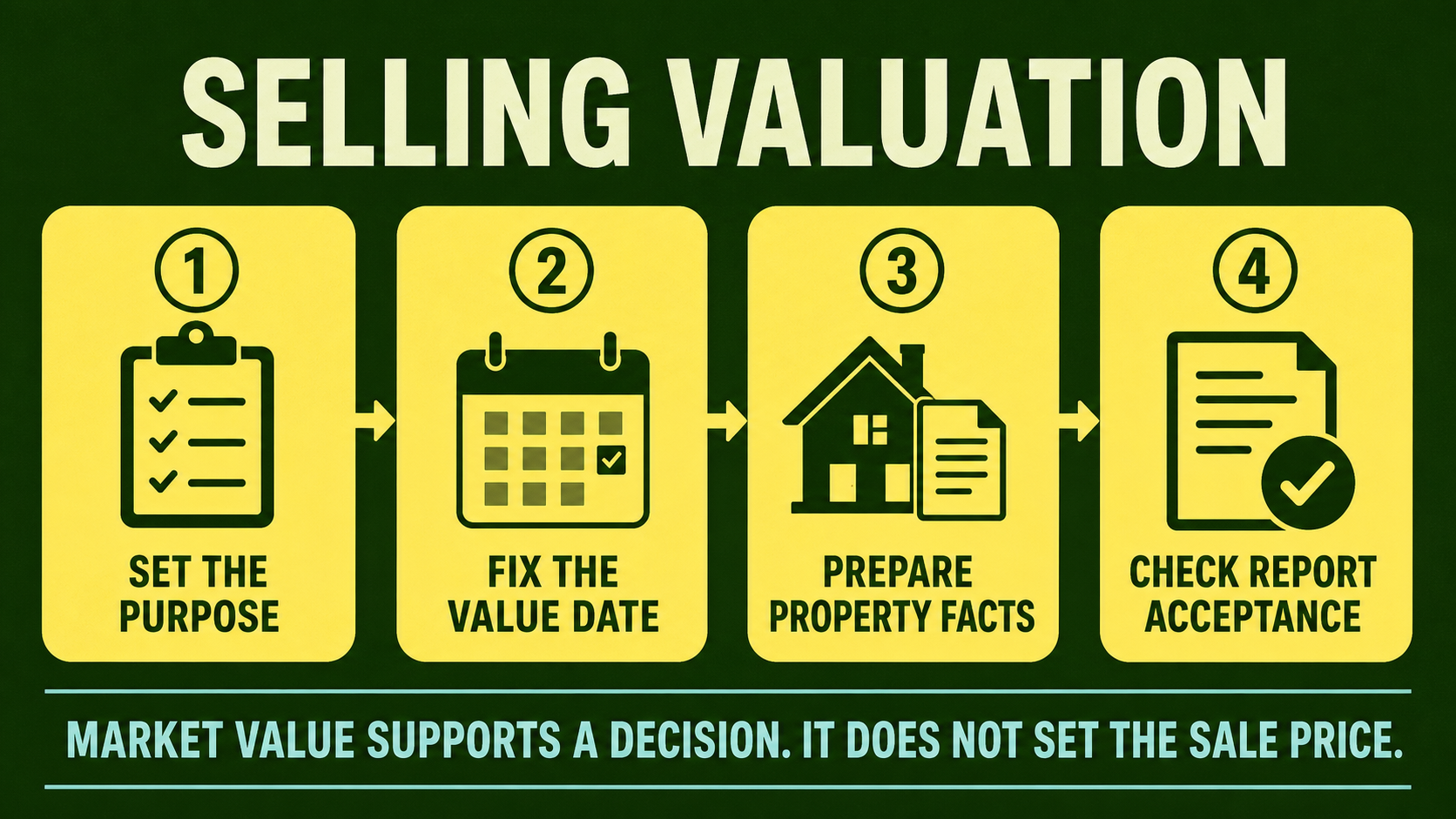
With the situation clear, start by separating the property facts from the decision the report must support.
When you prepare a home for sale, compare local market evidence from Tongelre with the asking-price decision so the valuation and marketing strategy stay distinct.
What an appraiser does for a sale
A property appraiser forms and reports an opinion of value for the assignment’s stated purpose and value date. The work can include an inspection, property and title information, comparable transactions, planning or leasehold research, condition observations and an explanation of the conclusion. The exact scope comes from the assignment, the applicable standards and the report recipient.
An estate agent has a different role. An agent can advise on presentation, launch timing, buyer response and asking-price strategy. An appraiser supplies value evidence under a defined method. A seller may need both forms of input, because the question “What is the market evidence?” is not identical to “How should I market this home?”
Seller preparation connects the asking-price decision to the property file. When municipal or forced-sale figures enter the discussion, market value and WOZ value keeps them separate from a market opinion.
The next question is why this detail changes the valuation.
Why the purpose and value date matter
Purpose controls what the report should answer. A sale valuation may support an asking-price conversation, a private negotiation, an ownership settlement or a request from a lender. These uses can require different evidence and different recipients.
The value date controls when the opinion applies. A report that describes a home on one date is not automatically a current answer months later. Market conditions, completed work, defects, permissions and comparable sales can change. Write the required date into your brief and ask how the recipient measures report age.
Do not ask an appraiser to make the value reach a preferred asking price. Ask what evidence supports the conclusion and which assumptions affect it. If the result surprises you, a focused review of facts and scope is more useful than an unsupported target.
Facts that shape a selling valuation
Market value
Market value is an estimated price under defined market conditions. It is evidence for a decision, not a promise that a buyer will pay that amount or that a home will sell within a chosen period.
Asking price
The asking price is a selling and marketing choice. It can reflect strategy, competition, urgency and the seller’s goals. It should not be presented as the appraiser’s independent value unless the assignment explicitly asks a compatible question.
Recipient and reliance
The recipient is the person or organisation expected to use the report. Ask whether a lender, court, notary, co-owner or adviser must be named. A report made for the seller’s own orientation may not meet another party’s acceptance rules.
Evidence file
The evidence file may include floor plans, permits, leasehold terms, homeowners’ association information, energy evidence, invoices and known defects. Dates matter. A planned extension and a completed extension are different facts.
Independence
Ask about earlier involvement with the property and relationships with the parties. Independence protects the usefulness of the opinion when the value affects a negotiation or a division.
Questions that belong with this decision
Before inspection, property valuation documents show what evidence is available. A quote depends on scope, property features and urgency, so property valuation cost factors should be compared with the work included rather than with a universal fee.
Providers should be compared on the same scope, as valuation quote comparison makes clear. A new mortgage introduces refinancing valuation as a separate purpose. These questions are related, but they do not target the same decision.
A selling valuation path
1. Define the decision
Write one sentence: “I need a valuation for [decision], to be used by [recipient], with value date [date].” If you only want a view of market evidence before marketing, say so. If a third party will rely on the report, name it.
2. Confirm the acceptance method
Ask the recipient whether it requires a particular report model, registration, validation, inspection method or report age. Do not assume that a report ordered for a sale will also satisfy a mortgage, court or tax question.
3. Prepare property facts
Gather the purchase history where relevant, floor area evidence, permits, drawings, leasehold information, homeowners’ association documents, energy documents, invoices and a clear list of defects or planned work. Mark unknowns instead of filling gaps with guesses.
4. Compare the provider scope
Ask each provider to state who signs the report, what is inspected, which valuation standard or method is used, whether validation is included, which documents are needed and when the final report will arrive. Matching those fields makes valuation quote comparison possible.
5. Check the delivered report
Confirm the property identity, purpose, value date, recipient, assumptions, evidence and conclusion. If a lender or other party asks for more information, ask which part of the file needs attention. Never ask for an unsupported change to the value.
Small shortcuts can change the report even when the property itself has not changed. Keep these traps in view.
Common mistakes and edge cases
Treating market value as an asking-price instruction
The two decisions can use overlapping evidence but have different owners. Keep the appraiser’s opinion and the agent’s marketing recommendation labelled separately.
Ignoring a future renovation
Tell the provider whether work is planned, permitted, underway or completed. A current-state valuation and a future scenario answer different questions. For a mortgage or construction loan, renovation valuation separates the current state from the future scenario before quotes are judged.
Omitting leasehold or apartment information
Ground rent, transfer conditions, homeowners’ association restrictions and major maintenance can affect the evidence. Share the documents at the start.
Reusing an old report without checking the date
There is no universal validity period for every purpose. Valuation report validity ties usable age to the recipient’s rule.
Asking for a number that supports a preferred deal
If the result is lower or higher than expected, check facts, assumptions and comparable evidence. The purpose of an independent report is weakened when the conclusion is treated as a target.
Before the appointment, settle the practical questions that affect the report.
FAQ
Does every seller need an appraiser?
No. A seller may use an agent’s market advice for a marketing decision. An appraiser becomes useful when independent value evidence is needed for a defined purpose or recipient. Confirm the request before paying for a report.
Can an appraiser set my asking price?
An appraiser can report an opinion of value. Asking-price strategy remains a separate selling decision that can include urgency, presentation and market positioning.
Can a sale valuation be used for a mortgage?
Only if the lender accepts that report and its purpose, method, recipient, validation and date conditions. Ask the lender first.
What should I send before the inspection?
Send the facts that define the property: plans, permits, leasehold or homeowners’ association documents, energy evidence, invoices, defects and planned work. The exact list depends on the assignment.
How quickly should I order a report?
Work backwards from the recipient’s deadline and allow time for document questions, inspection, report writing, validation and corrections. A provider’s advertised turnaround is not the same as an acceptance deadline.
Before you request a valuation, write down who will use it and what decision it must support. A seller may need market-value evidence, while an estate agent may separately advise on asking price and marketing. Ask the provider which facts and value date the report will use. Contact us if you want to check your questions before you order.
Ask about a selling valuation →