Appraiser for Refinancing a Mortgage: What to Check
Understand when refinancing can involve a property valuation, how loan-to-value fits the decision, and which lender conditions to confirm before ordering a report.

When this valuation matters
If you are refinancing, connect the current debt, value date, planned work and acceptance conditions before you order a report. Homeowners, advisers and lenders can connect the current debt, value date, planned work and acceptance conditions before ordering a report.
Table of contents
- TL;DR
- What a refinancing valuation does
- Why the lender’s method matters
- Refinancing facts that matter
- A refinancing valuation path
- Common mistakes and edge cases
- FAQ
TL;DR
When you refinance, confirm the lender, value date, report method and any extra borrowing before you book. A report for one mortgage decision may need new evidence for another, especially when the home or loan has changed.
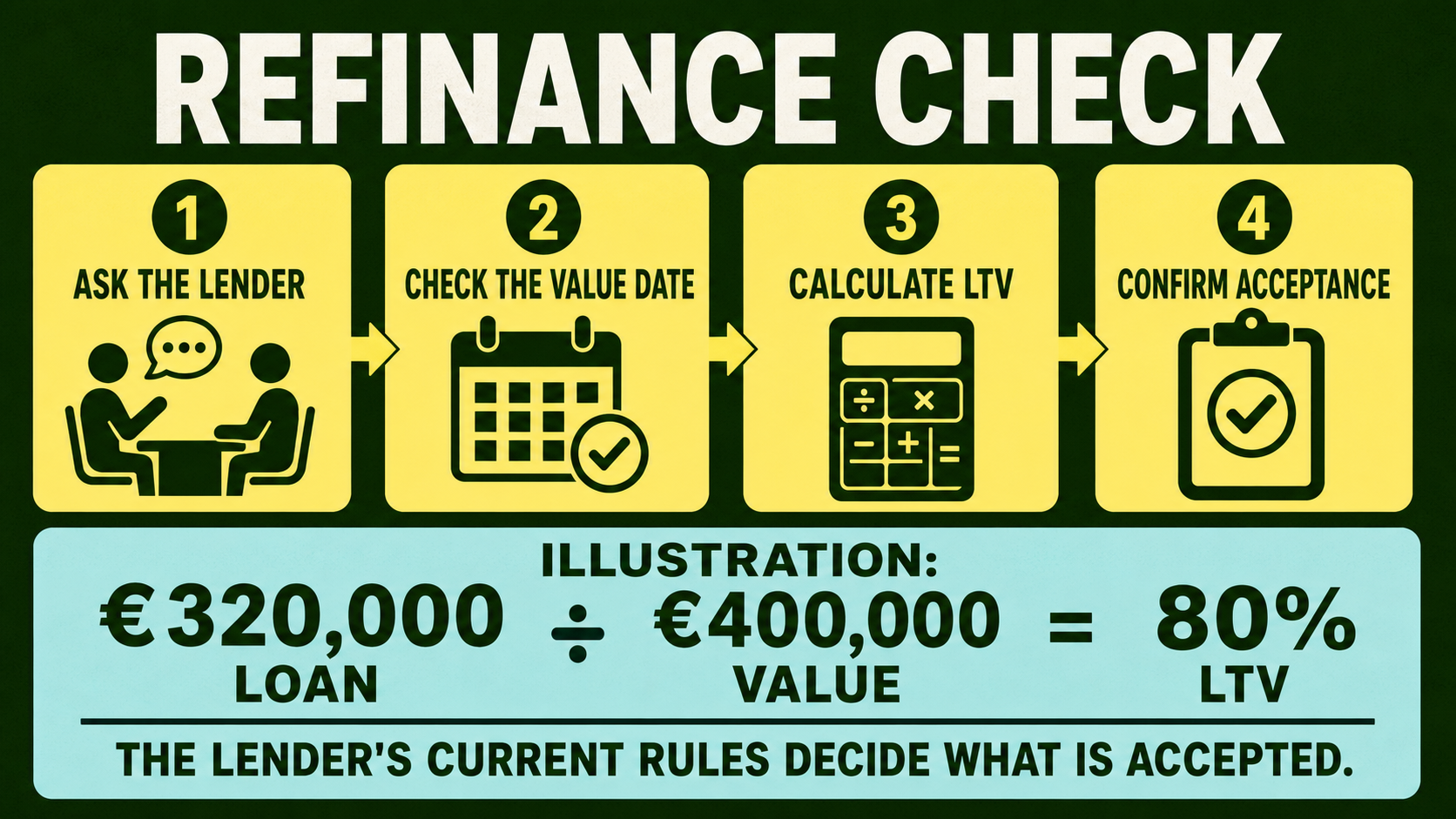
Loan-to-value is a simple ratio: the relevant loan amount divided by the reported property value. An illustration using €320,000 of debt and a €400,000 value gives 80% LTV. The calculation helps you understand the relationship. It does not decide affordability, interest pricing, NHG eligibility or acceptance.
NHG describes physical and hybrid valuation routes for named cases. Its current guidance also gives a 90% limit in some refinancing or increase situations that use a hybrid valuation with renovation or energy budgets. That is a specific NHG example, not a universal rule for every lender. Ask for the current conditions that apply to your file.
With the situation clear, start by separating the property facts from the decision the report must support.
When you refinance a mortgage, compare current local market evidence from Heeze with the new file’s purpose and lender requirements before treating an old report as current.
What a refinancing valuation does
A refinancing valuation reports an opinion of value for a defined date and mortgage purpose. The lender can use that opinion when assessing the property as security, subject to its own credit, income and product rules. The appraiser does not approve the mortgage and does not decide whether a lender must offer a lower rate.
The assignment can differ when you only replace an existing loan, increase the loan, add renovation funding or move from one lender to another. Write down what changes. A lender may treat a pure refinance differently from a refinance that adds borrowing.
When a mortgage valuation report is needed frames the lender’s wider question. Refinancing adds the existing loan, the proposed change and the lender’s current acceptance conditions.
The next question is why this detail changes the valuation.
Why the lender’s method matters
The same house can be described through a physical report, a hybrid method or another lender-approved method. The method is not interchangeable by default. The lender may specify who can produce or validate the report, how recent the value must be, whether renovation is included and where the report is submitted.
Ask for the current written conditions before you compare quotes. A cheaper report that the lender rejects costs more time than a report ordered to the correct scope. Also ask which amount belongs in the LTV calculation: current debt, proposed debt, an energy budget, a renovation amount or another figure.
Refinancing facts that matter
Loan-to-value
LTV compares a relevant loan amount with a reported property value. Formula: loan amount / property value x 100. In the illustration, €320,000 / €400,000 x 100 = 80%. The lender decides which loan amount and value it uses.
Value date
The value date is when the reported opinion applies. The value date can differ from the order date and the lender’s offer date. Ask how the lender measures age and whether the date must be current at submission.
Current value and value after work
A refinancing file that includes planned improvements can need a current value, a value after work or both. Provide plans, specifications, permits and budgets when the assignment requires them. A report that covers current condition alone is not automatically a post-renovation analysis.
Acceptance and validation
Acceptance is the lender’s decision about whether the output fits its rules. Validation is a quality-control step described by some report routes. Neither word removes the need to check recipient, purpose and date.
Income and security
Property value is only one part of a mortgage decision. Income, existing debt, term, rate, affordability and product rules can also matter. Do not convert an LTV illustration into a personal borrowing conclusion.
Questions that belong with this decision
An NHG case is governed by NHG valuation requirements, while valuation report validity determines whether an older report remains usable.
The refinancing file should include property valuation documents that show the current property and missing evidence. Planned work may bring in renovation and construction-loan valuation and energy-label valuation before a quote is compared.
A refinancing valuation path
1. Ask the lender for the brief
Record the lender, purpose, loan amount, report method, validation method, value date and submission channel. Ask whether the case is a pure refinance, an increase, a renovation or an energy-related request.
2. Calculate an initial LTV illustration
Use the amount the lender tells you to use. For orientation only, divide that amount by the value you are testing. Label the result as an illustration. Include assumptions, rounding and exclusions. The lender’s calculation controls the application.
3. Prepare the property evidence
Collect floor plans, permits, leasehold terms, homeowners’ association documents, energy evidence, invoices, renovation specifications and information about defects. Mark the dates. Missing or unclear facts can trigger follow-up questions.
4. Choose a provider for the accepted method
Ask what the provider will deliver, who signs it, whether validation is included, which inspection method applies and how long delivery takes. Compare quotes only when the scope is equivalent. The lender’s acceptance rule is the first filter.
5. Check the report before submission
Confirm the property identity, purpose, recipient, value date, assumptions, loan amount used and validation status. If the lender asks for changes, ask whether the issue is missing evidence, a date condition or an acceptance rule. Do not request a value change without evidence.
Before you book, check the mistakes that can create extra work or leave you with the wrong report.
Common mistakes and edge cases
Ordering before asking the lender
A report can be technically sound and still fail the lender’s method. Get the brief first.
Treating a rate request as a valuation request
A lower rate can depend on product terms and LTV bands, but the lender decides how it verifies value. Do not assume a valuation alone will change pricing.
Adding renovation money without describing the work
State whether the work is planned, underway or complete. Include a specification and budget when requested. A post-work value is an assumption that needs evidence.
Using a hybrid method for a case it does not cover
NHG and lenders define where a hybrid method can be used. Ask the actual lender. Do not generalise from one NHG example.
Reusing an old purchase report
A purchase report may have the wrong purpose, recipient or date. Valuation report validity determines whether those conditions still fit before the report is reused, and the lender should confirm acceptance.
If cost, timing or acceptance still concern you, ask the provider to state each condition before the appointment.
FAQ
Is a valuation always required when refinancing?
No universal answer applies. A lender can accept a different method, existing evidence or a hybrid method in a named case, or require a full report. Ask the lender before ordering.
What does 80% LTV mean?
It means the relevant loan amount is 80% of the reported value in that calculation. The illustration €320,000 / €400,000 = 80% does not include income tests or lender-specific adjustments.
Can I choose the appraiser?
You can compare available providers, but the lender can set requirements for status, method, validation and report delivery. Confirm that the chosen method is accepted.
Does a higher valuation guarantee more borrowing?
No. Income, debts, affordability, product limits and lender policy also matter. A valuation reports property evidence; it does not approve credit.
What if the lender changes its requirements?
Ask for the current written brief and check whether the report already ordered can satisfy it. If not, ask the lender and provider how to correct the scope before relying on the report.
Refinancing can involve a valuation, but the required method and report recipient depend on the lender, the amount and the reason for the change. Ask for the current report, date, validation and renovation conditions in writing. Contact us if you want to check which questions to take into your lender conversation.
Ask about a refinancing valuation →