Best Appraiser for Healthcare Real Estate: What to Compare
Compare appraisers for healthcare real estate by checking use, care operations, access, leases, regulation, building condition, evidence and the report purpose.

When this valuation matters
If you are valuing healthcare real estate, connect accessibility, leases, use and operating evidence without reducing them to one figure. Care organisations, owners, investors, lenders and advisers can select an appraiser who can connect accessibility, leases, use and operating evidence without treating them as one figure.
Table of contents
- TL;DR
- What the choice should cover
- Why healthcare facts matter
- Five checks before choosing
- Prepare and compare
- Scenarios and limits
- Common mistakes
- FAQ
TL;DR
When choosing a healthcare-property appraiser, ask how the person will handle building function, care use, leases, occupancy, condition and the value date. A good brief makes clear which evidence belongs to the property and which belongs to the operator.
- State the property, use, interest, value date, purpose and report recipient.
- Describe rooms, access, circulation, installations, shared areas and condition.
- Gather leases, operator agreements, plans, maintenance records and energy information.
- Separate the building from care income, staffing, equipment and contracts.
- Compare inspection, research, method, assumptions, delivery date and fee together.
That gives you a useful starting point. The next question is how the assignment works for the person who will rely on it.
Ask how local transactions, rents, condition, access, use and competing supply will be weighed. Broad market indicators can frame the conversation, yet the property needs local and asset-specific evidence. If you are assessing healthcare property near Eindhoven, consider a property valuation in Aarle-Rixtel as residential market evidence, then analyse care use, access, leases and operating evidence separately.
What the choice should cover
A property valuation is an opinion of value for a stated property interest, purpose and date. For healthcare real estate, the work may include an inspection, review of plans and leases, market research, a valuation method and an explanation of assumptions. The assignment can mention care information without becoming a clinical or operating assessment.
The wider special-property valuation context keeps use, rights and building evidence in one brief. A candidate should be able to say which records are needed and how each record relates to the property question.
The recipient matters early. A lender, buyer, owner, care provider, court or investor may need different value definitions, dates and report formats. The phrase healthcare property does not settle whether the assignment concerns the freehold, a leasehold, a vacant building, an occupied investment or a planned change.
Here is why the distinction matters when you are arranging the report.
Why healthcare facts matter
The property can support a care model through room sizes, circulation, lifts, accessible entrances, fire measures, treatment spaces, shared areas and technical installations. A building that suits one service may need work for another. A care organisation’s income and staffing can explain the operation, yet they do not automatically become property value.
NRVT’s care-property material gives a useful question for provider selection: can the candidate connect the use and the building without turning a property report into a clinical judgement? A general residential background does not answer that question for a care home, clinic or assisted-living property.
Energy, maintenance and permission records also need a boundary. The brief can identify known records, restrictions, use, alterations and planned changes. The valuer can state which items affect the assignment and which need a separate specialist or authority. A property report does not decide every care, planning or building-safety question.
With the purpose settled, you can work through the checks in an order that mirrors the decision.
Five checks before choosing
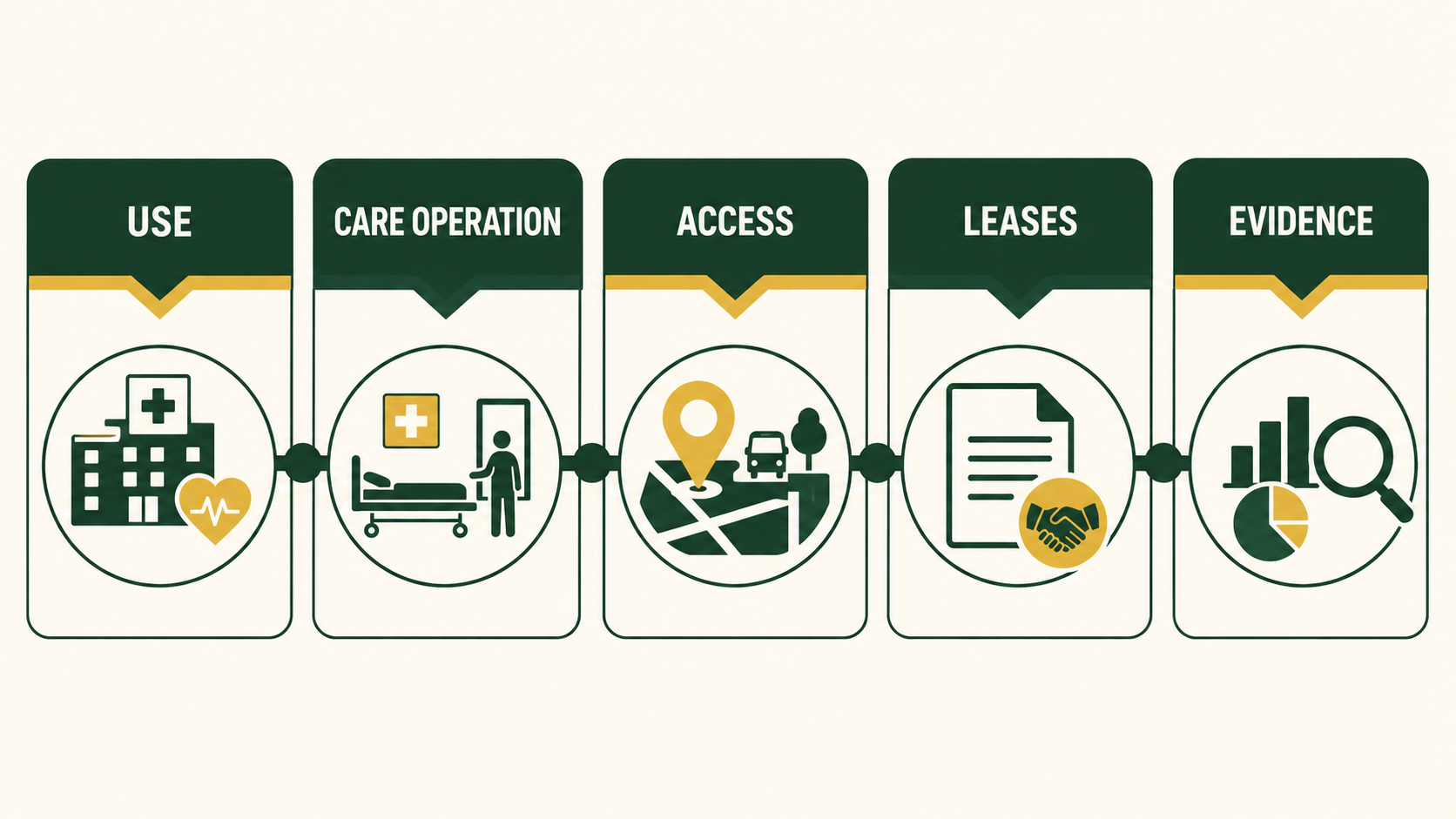
1. Use and physical specification
Describe rooms, floor areas, shared spaces, circulation, lifts, entrances, parking, gardens, installations and condition. State which parts belong to the interest being valued. A candidate should ask whether the current use, vacant use or a different permitted use is relevant.
2. Care operation
Separate building evidence from care income, staffing, occupancy, service mix and operator choices. These records may explain the asset’s operating context. They do not automatically become a property value. Ask which periods and adjustments are useful and which care matters fall outside the assignment.
3. Access and safety evidence
List accessible entrances, circulation, lifts, emergency access, parking, transport links, fire-safety records and known defects. The property brief can identify a question for a responsible specialist. It should not turn a valuer into a building inspector or care regulator.
4. Leases and rights
Add the lease, operator agreement, rent, term, break options, repair duties, service obligations, incentives and side letters. A leased clinic and an owner-operated care home present different questions. Missing terms should be recorded as an uncertainty.
5. Evidence and report recipient
Good preparation keeps a missing document from becoming a late surprise.
Prepare and compare
- Write the decision. Put the purpose, recipient, value date and property interest at the top.
- Draw the property boundary. List rooms, shared areas, land, installations and equipment included in the brief.
- Describe the care use. Add the operator, service model, occupancy, material changes and planned use without treating them as property value.
- Gather rights and records. Include leases, operator agreements, plans, access information, maintenance records and energy data.
- Build the evidence file. A care-property file needs property valuation documents for plans, leases, access, condition and known defects.
- Ask about method and limits. Request the proposed method, assumptions, missing-information treatment and any separate clinical, legal or building questions.
- Compare the full scope. After the property scope is written down, compare valuation quotes by the work promised and evidence required.
Scenarios and limits
A care home with a long lease
The lease may be central to the value of the interest. Give the appraiser the full agreement, rent review terms, repair duties, service obligations and operator investment. A sale summary can omit terms that change the property question.
A clinic with mixed medical and office use
List each use, room group, access arrangement and lease. A mixed building may need components rather than one broad label. Your report should explain how the parts relate to the stated interest.
A planned conversion
Keep the current property separate from a proposed ward, clinic, care home or accessibility change. A plan or intention does not prove permission, funding, building compliance or demand. The future case needs stated assumptions.
A building with vacancy or renovation
Describe the vacant period, works, costs, condition and expected timing. Ask which facts are observed, supplied or assumed. A valuation date fixes the context for the conclusion.
Keep these points in view when you ask for the report.
Before you book, check the mistakes that can create extra work or leave you with the wrong report.
Common mistakes
- Choosing from a healthcare label while leaving the use and property boundary undefined.
- Sending care income without the period, operator context or explanation of unusual events.
- Treating an intended use as an approved use.
- Omitting operator agreements, rent incentives, repair duties or access records.
- Treating a valuer’s report as a clinical, legal or building-safety certificate.
- Comparing fees before inspection, research and report scope match.
Each mistake has the same remedy: write the property, purpose, evidence and boundary before the quote conversation.
Before the appointment, settle the practical questions that affect the report.
FAQ
Can a residential appraiser value a care property?
Ask about registration, experience, object type and proposed scope. A residential background alone does not answer whether the person can handle a healthcare assignment.
Does care income equal property value?
No. Income describes part of the operation. The value opinion also depends on the property interest, use, rights, condition, market evidence, assumptions and date.
Which records matter most?
Start with plans, floor areas, leases, operator agreements, occupancy information, maintenance records, energy data, access records and known defects. The recipient and method may add other requirements.
Can a valuation confirm a care permission?
No. The brief can record the stated use and known information. The responsible authority or specialist answers whether a use or alteration is allowed.
Will a lender accept the same report as a care provider?
Not automatically. Valuation report requirements put the recipient’s question beside the care and building evidence. Confirm the lender’s conditions before the assignment is accepted.
Is a mixed care and residential building one property question?
It can be one assignment with separate components, or it can require a defined interest and method. List each use, right, lease and physical area so the candidate can explain the boundary.
Write down the property, care use, access, leases, condition, value purpose and report recipient before comparing appraisers. Add plans, occupancy information, maintenance records, energy data and permission notes when they affect the question. Contact us if the healthcare-property facts need to become a focused brief. Do not send passports, contracts, bank details or other personal documents through the public form.
Ask about healthcare property valuation →