Commercial Property Appraiser: What a Useful Valuation Brief Covers
A practical guide to valuing offices, retail and hospitality property, with a clear way to organise leases, methods, evidence, assumptions and uncertainty.

When this valuation matters
If you are valuing commercial property, connect leases, use, income and the building itself. Owners, investors, lenders and advisers face this question when a shop, office, hospitality property or mixed-use asset needs a value that others can inspect and rely on.
If the main question is which professional fits a leased unit or mixed-use property, a specialist for commercial-property valuation should connect the building, lease and income evidence.
Table of contents
- TL;DR
- What a commercial property appraiser does
- Why scope and method matter
- The five-part commercial assignment map
- How to prepare the brief
- Common mistakes and edge cases
- FAQ
TL;DR
For commercial property, name the asset, the property interest, the income evidence and the recipient before choosing an appraiser. A report becomes easier to assess when leases, vacancy, operating figures and physical condition are connected to one stated value question.
The NRVT commercial-property regulation says the report should describe the method or methods used and recommends comparing at least two methods where appropriate. That does not mean every small property needs the same calculation. It means the method should fit the object, the market and the available data, and the reason for any limitation should be visible.
With the situation clear, start by separating the property facts from the decision the report must support.
If you are assessing commercial property near Eindhoven, compare residential market evidence from Helmond with the asset’s leases, use and income records before setting the scope.
What a commercial property appraiser does
A commercial property appraiser forms and reports an opinion of value for a stated purpose and value date. The work may involve inspection, title and planning research, lease review, market rent evidence, comparable transactions, operating information and a model or calculation. The exact scope depends on the property and the report recipient.
NRVT lists separate specialisations, including commercial property and rural and agricultural property. This matters when an asset crosses categories. A building with a home above a shop, a care property with operating characteristics or a farm with a holiday use can require the scope and experience to be stated clearly.
Residential property valuation supplies the shared property evidence, while this assignment adds lease and income evidence that can change the valuation logic.
Now the practical consequence becomes clear: the evidence has to answer the question behind the assignment.
Why scope and method matter
The same building can produce different questions. An owner may need market value for a sale. A lender may need a report at a particular date. An investor may focus on the effect of a lease, vacancy or operating assumption. A court or co-owner may need a historical value and a defined division date.
The tempting shortcut is to compare a price per square metre and stop. That can be useful as one signal, but it can hide lease terms, vacancy, incentives, condition, legal use, service charges or capex. The opposite shortcut is to assume an income model is always superior. It is only as credible as the rent, costs, growth, vacancy, yield and other inputs.
Comparable quotes depend on matching scope; valuation quote comparison keeps work, evidence and assumptions aligned before fee or delivery time is compared.
Next, turn the general explanation into questions you can put to the appraiser.
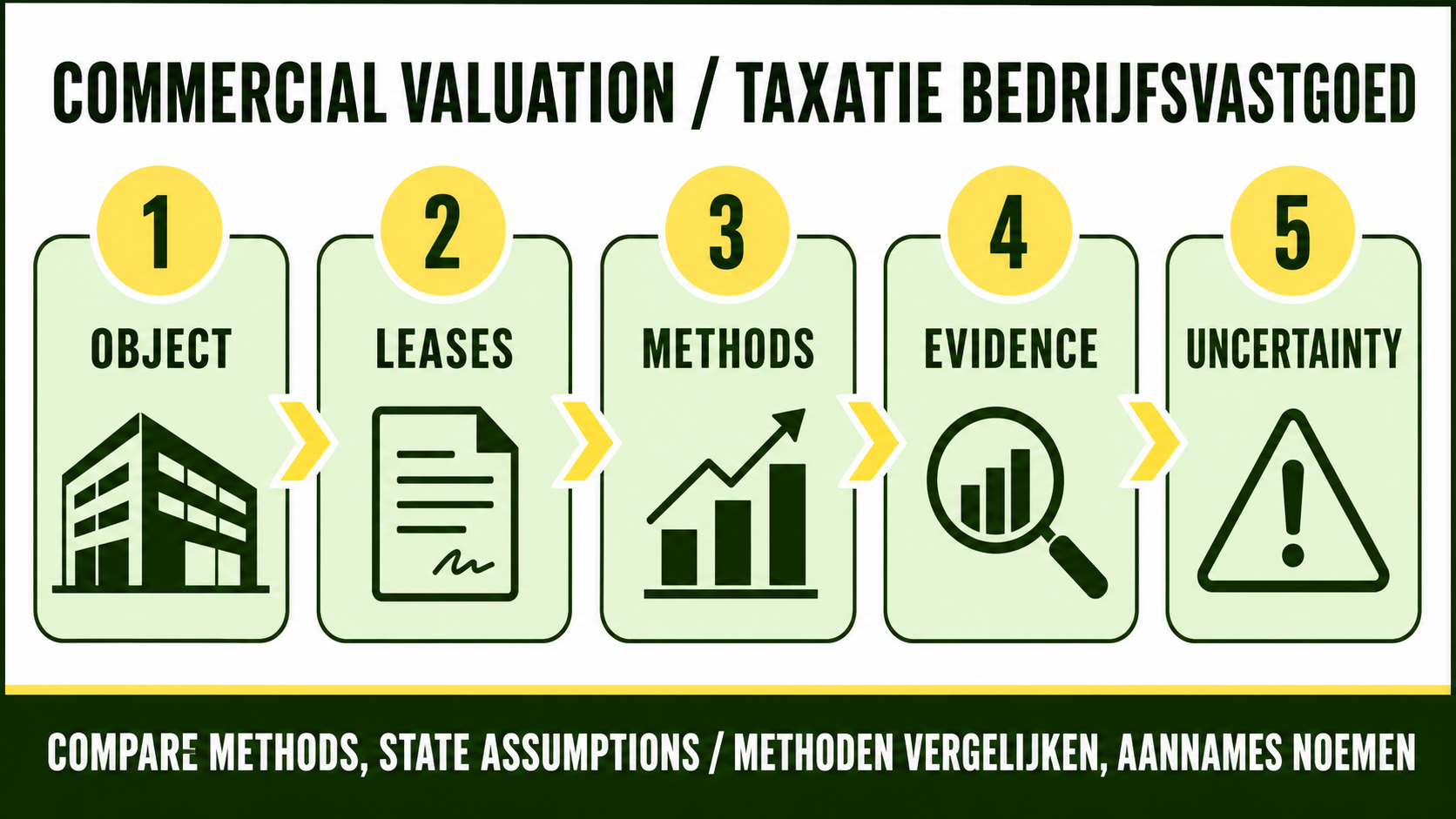
The five-part commercial assignment map
1. Object
Describe the address, units, floor area, ownership, legal rights, use and any mixed-use element. Confirm whether the brief covers the whole property, a unit, a leasehold interest or another defined interest.
2. Leases
List tenants, terms, break options, indexation, incentives, arrears, service charges, repair obligations and vacancy. Mark information as current, estimated or missing. A rent roll without the underlying agreements can be an incomplete picture.
3. Methods
Ask which methods could fit the property and why. The answer may draw on comparable transactions, income or other approaches. If more than one method is used, ask how the results are reconciled and which inputs shape the conclusion.
4. Evidence
Gather leases, plans, permits, energy information, condition reports, operating data where relevant and comparable evidence. Property valuation documents provide the general file structure before commercial-specific material is added.
5. Uncertainty
Ask what is uncertain because of missing information, thin market evidence, changing occupancy, unusual use or wider market conditions. Uncertainty is not an automatic error. Hiding it is the problem.
Good preparation keeps a missing document from becoming a late surprise.
How to prepare the brief
- Name the decision and recipient. Write who will rely on the report and for what decision.
- Define the interest. State the object, units, rights, use and value date.
- Create a lease evidence file. Include signed agreements and amendments alongside the summary.
- Separate building from business. For hospitality or operating assets, identify which facts concern the real estate and which concern the business operation.
- Ask for method fit. Invite the appraiser to explain the useful methods and the strongest and weakest inputs.
- Review the output. Check the object, assumptions, dates, method, comparables, sensitivity and uncertainty.
If a quote has no space for these questions, ask what is included and what is excluded. Scope and scope alter a quote, so property valuation cost factors belong in the cost conversation alongside inspection and research tasks.
Before you book, check the mistakes that can create extra work or leave you with the wrong report.
Common mistakes and edge cases
- Treating a commercial unit as a home because it has a kitchen or residential-looking fit-out.
- Using a headline rent without checking term, incentives, vacancy and repair obligations.
- Mixing the value of the building with the operating return of the operating business.
- Ignoring planning or permitted-use limits.
- Comparing reports with different value dates or interests.
- Reporting a precise number while important lease or condition inputs remain unverified.
Mixed-use property, vacant premises, a short lease, an unusual tenant, a development option or a rural element should be flagged before the quote is accepted. These cases do not have one universal shortcut. They need a clear scope and an explanation of which facts shape the result.
Use these questions to test whether the proposed work fits your situation.
FAQ
Does every commercial valuation need two methods?
Not in exactly the same way for every assignment. NRVT guidance says the method depends on the object, market and available data, and the commercial-property regulation recommends comparing at least two methods where appropriate. Ask the appraiser to explain the fit.
Can I give the appraiser only a rent roll?
That does not give enough detail to understand all lease rights and obligations. Provide the agreements, amendments, vacancy information and relevant operating or service-charge evidence.
Is a small shop easier to value than an office building?
Size is only one factor. A small unit can have thin comparable evidence, an unusual lease or a mixed-use restriction. Scope should follow the evidence problem as well as the floor area.
Does the report value the business inside a hotel or restaurant?
That depends on the assignment. Ask which real-estate interest is being valued and which operating information is used. A business valuation and a real-estate valuation are not interchangeable.
Why should uncertainty be written down?
So the recipient can understand how much confidence to place in the result and which inputs deserve further checking. Clear uncertainty is more useful than false precision.
For commercial property, identify the building, use, lease position, income evidence and intended recipient before comparing quotes. A short brief makes it easier to spot where a method or assumption differs. Contact us if you want to turn your property facts into focused questions for an appraiser.
Ask about commercial property valuation →