Choosing a Property Valuer for Your First Home or Next Home
Choose a Dutch property valuer for a first home or a move by matching the report to financing, evidence, timing, tax rules and the property's complexity.

When this valuation matters
If you are buying your first home or moving to your next one, match the appraiser’s experience to the property and decision in front of you. Advisers and lenders can help either buyer match the appraiser’s experience to the home and the decision in front of them.
The distinction lets you brief a provider and compare quotes without treating a starter tax rule or an NHG boundary as a substitute for a property valuation.
TL;DR: The practical difference
A first-home buyer needs more help understanding the report, mortgage evidence and condition questions. A repeat buyer may bring earlier reports, a more unusual property or a tighter comparison question. Choose the appraiser and briefing around the home and decision in front of you.
Use this order:
- ask the lender or other recipient what report it accepts;
- separate the first home or next home question from any tax or sale question;
- provide the same property facts and documents to each provider;
- compare the written scope, person, method, timing and total cost;
- record which questions remain open before choosing.
The right result is a quote that fits the decision and recipient. The cheapest option or the provider with the most experience for one buyer label may still miss your needs.
Keep that purpose in view as the details come in; each one matters because it changes what the appraiser needs to test.
When you compare a first home or a next home, keep address-specific property evidence from Gestel beside lender and timing requirements so the property context stays tied to the decision.
At-a-glance comparison
The following definition list keeps the comparison readable on a narrow screen.
- First-home focus
- Clarify the lender's accepted report, financing evidence, property condition and any starter or guarantee rule that the buyer may need to confirm.
- Next-home focus
- Clarify whether the move involves one report or linked reports, the current home's sale position, two value dates and any timing dependency between sale and purchase.
- Shared requirement
- Give the provider the purpose, recipient, property facts, documents, method, deadline and unusual features in one written brief.
- What the valuer cannot decide
- A valuer does not decide mortgage affordability, tax exemption eligibility or whether a purchase contract should be signed.
Use those answers to turn the conversation with a valuer into a brief that matches the home and the decision in front of you.
These are the details worth checking before you compare providers or send the file.
First home: what deserves attention
What the assignment needs
Start with the property being bought and the organisation receiving the report. Ask about the value date, physical or hybrid method, validation, maximum report age, delivery channel and document format. Include the agreed price as context, not as proof of market value.
Buyer preparation connects the purchase questions to the evidence needed for a quote. Add plans, permits, leasehold terms, homeowners’ association information, known defects and planned works. If something is missing, say so rather than leaving the valuer to discover it late.
What the 2026 thresholds do and do not say
The Tax Administration says the 2026 starter transfer-tax exemption has conditions including being younger than 35 at acquisition, using the home as a main residence and a maximum full economic value of €555,000. The rule concerns transfer tax and must be confirmed for the buyer’s facts. It does not set the market value, tell you which provider to choose or replace the lender’s checks.
NHG’s published 2026 boundary is €470,000, or €498,200 when the loan includes energy-saving provisions. The published 2025 boundary was €450,000, so the standard boundary increased by €20,000. The arithmetic rate is (€470,000 - €450,000) / €450,000 × 100 = 4.44%, rounded to two decimals. That change describes the guarantee boundary, not a 4.44% increase in the value of every home.
Limitations for a first-home brief
Do not ask a provider to confirm that you qualify for a tax exemption or mortgage. Ask the responsible organisation. A lender can assess income, debts, interest and other obligations even when the property value is known. Mortgage valuation report requirements keep the property evidence separate from the lender’s affordability assessment.
Next home: what changes
What the assignment may contain
Tell the provider whether you need a report for the home you will buy, a separate value for the home you will sell, or advice about a different purpose. Confirm who receives each report. The current home may have a mortgage, leasehold, rental arrangement, extension, renovation or sale deadline that changes its evidence needs.
When a current home is part of the decision, seller preparation identifies the information needed for that separate property. If two reports are needed, keep their purposes and value dates separate. One report cannot be assumed to answer every question about the old and new property.
Timing and evidence
Movers coordinate a purchase condition with a sale, mortgage offer or completion date. Write the steps in order and ask each provider whether inspection, document review, report, validation and corrections are included. A provider who is suitable for the next home may not be available for the current home at the same time.
Limitations for a mover’s brief
Do not treat an asking price, expected sale price or online estimate as a report for the lender. Do not assume the existing report can be reused for a new purpose. The stated purpose and recipient determine valuation report requirements.
Decision framework for comparing quotes
Use a small score to expose unanswered questions. Give each candidate quote 0, 1 or 2 points for each criterion:
- Purpose fit: does the quote name the decision and property correctly?
- Recipient fit: does it match the lender, adviser or other recipient’s method and format?
- Evidence plan: does it explain the inspection, documents and unusual facts that will be considered?
- Timing: does it state inspection, report, validation and delivery dates?
- scope: does it address a first purchase, sale and purchase, leasehold, improvements or another feature that changes the brief?
Add the five scores. The maximum is 10. This is an original checklist for your own shortlist, not a provider ranking. A quote with 8 points is not automatically better than one with 7 if the two open questions concern the lender’s acceptance or a legal feature.
Only after the assignments are matched does valuation quote comparison add a detailed 100-point scope check.
Use-case scenarios
Scenario A: First purchase close to a threshold
A buyer is under 35 and the home’s full economic value appears close to €555,000. The buyer should ask the Tax Administration or adviser to check the exemption conditions, and ask the lender which report it accepts. The valuer should receive the property facts and report purpose. The threshold is a question for the tax rule, not a target value for the report.
Scenario B: Moving while selling the current home
A couple is buying a next home while preparing the current home for sale. They ask whether one provider can handle the two purposes and whether separate reports, value dates and recipients apply. They compare the written scopes and timelines rather than assuming the provider’s familiarity with movers covers both assignments.
Scenario C: A first purchase with planned improvements
A first-time buyer includes an extension and energy work in the financing. The brief should separate existing condition, planned work and value after completion. The lender’s method and evidence rules come first. A contractor quote shows intended work, not completed work or a guaranteed increase in value.
Alternatives, combined decisions and neither case
When a different report is needed
If the question is sale pricing, inheritance, division of assets, a dispute or a building condition, ask whether a valuation report is the right product. A sales estimate, building survey and mortgage valuation answer different questions. Real-estate agent versus appraiser keeps those roles distinct.
When two linked reports make sense
A move can require two reports with different purposes. Treat them as related assignments but keep recipient, property, value date and evidence distinct. One report may inform your planning without being accepted for the other decision.
When neither buyer label is enough
Age, first-time status or moving status does not describe the property. Leasehold, rental use, an extension, a homeowners’ association, foundation concern or unusual ownership can matter more. Put those facts in the brief even if the buyer’s situation looks straightforward.
The visual difference in preparation
The image uses a smaller document set beside a larger moving set to show why the brief changes. It is a visual reminder to separate the buyer label from the property evidence and recipient rule.
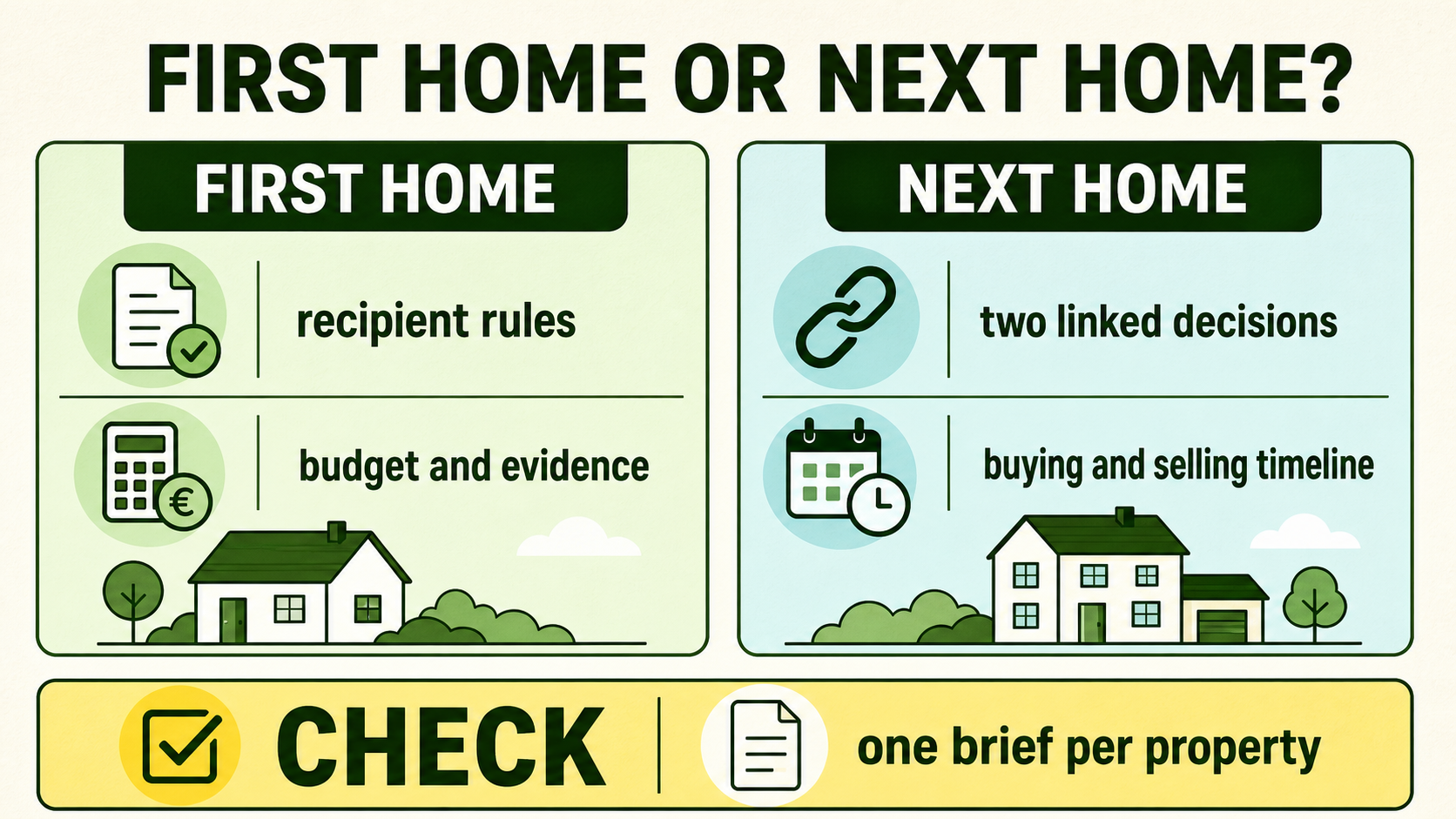
Put the options beside each other first; the reasons behind the difference come next.
Where the comparison can mislead
The first-home versus next-home distinction helps frame questions, yet it does not determine the report. A first-time buyer can have a complex leasehold or renovation, while a mover can have a simple purchase. Tax and mortgage thresholds can also change, and a public figure does not resolve the buyer’s personal facts.
The CBS count of 518,000 starters in 2024 compared with 560,000 in 2023 gives housing-market context, with original arithmetic of a 7.5% decline. It does not explain the reason for the change, measure demand from every possible definition of “starter” or predict whether one buyer needs one type of provider. Use the data as context, then return to the actual report purpose.
If cost, timing or acceptance still concern you, ask the provider to state each condition before the appointment.
FAQ about first and next homes
Do first-time buyers need a different type of property valuer?
Not automatically. The report purpose, recipient, method, property and evidence determine the brief. First-time buyers need more help clarifying lender and budget questions, while the underlying professional requirements still depend on the assignment.
Does a starter tax exemption change the property value?
No. The 2026 exemption has buyer, use and value conditions, but it does not instruct a valuer to reach a particular figure. Confirm eligibility with the Tax Administration or a qualified adviser.
Does NHG apply only to first homes?
No general conclusion follows from the buyer label. NHG has a 2026 boundary and product conditions; eligibility depends on the loan, property and current rules. Ask the lender or NHG for the current application requirements.
Should a mover use the same valuer for both homes?
That can be convenient, but convenience does not answer whether the choice fits. Check competence, independence, availability, purpose, recipient and whether separate reports are required.
Can an existing report be used for the next mortgage?
Only if the current recipient accepts it for the new purpose and its date, method, property condition and format still fit. Valuation report validity tests those conditions rather than age alone.
Does an NHG or tax threshold tell me which quote is best?
No. Thresholds help identify questions for the lender or Tax Administration. Compare provider quotes by purpose, scope, recipient acceptance, evidence and timing.
Once those points are clear, gather the records that let the appraiser test them.
Choose the brief before the provider
For a first home, start with the lender’s accepted method and the evidence needed for the property. For a next home, separate the purchase and sale purposes and write the two timelines. Property valuation documents then identify the evidence for each brief before written quotes are compared.
Next steps
Prepare one page with purpose, recipient, property facts, documents, method, value date and deadline. For a move, make one version per property or report purpose. Beste Taxateur provides general information and does not determine tax eligibility, mortgage affordability or endorse an individual provider.
A sound provider screen checks appraiser independence and conflicts of interest, interprets appraiser reviews and ratings, avoids common selection mistakes and matches an appraiser for buying a home to the report’s purpose.
A first purchase often centers on recipient rules and affordability evidence; a move can involve linked purchase and sale decisions. Confirm the current rules for your facts.
Ask about choosing a valuer →