When Is a Valuation Report Needed for a Mortgage?
Learn when a Dutch lender may ask for a valuation report for purchase, refinancing or home improvements, and how value, LTV and report age affect the process.

When this valuation matters
If you are arranging a mortgage, match the valuation report’s format to the loan and property before ordering it. Buyers, homeowners, advisers and lenders can check when a report is needed and what the file must contain.
TL;DR
Start with the lender’s current checklist. A report may be needed for a purchase, refinancing, extra borrowing or a change to the home, and the accepted method can depend on loan-to-value, NHG, property type and report age.
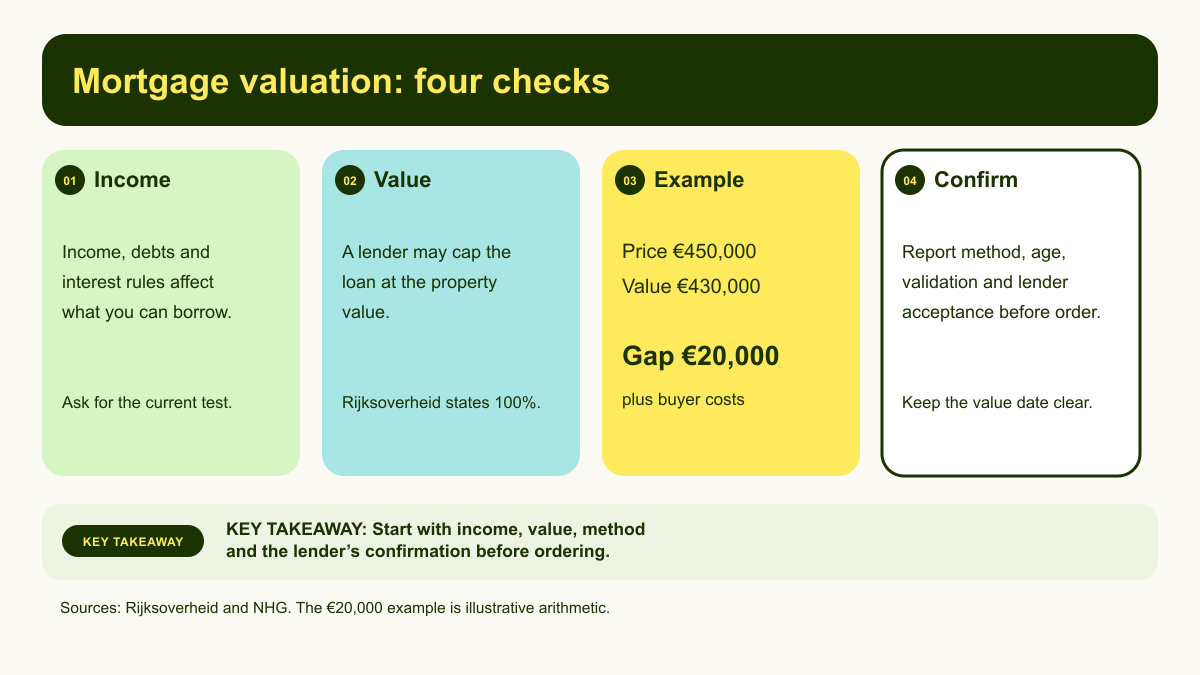
Rijksoverheid states that a mortgage can be up to 100% of the home’s value, while income, debts and statutory affordability rules also apply. In an illustrative purchase of €450,000 with a €430,000 valuation, the €20,000 difference creates a funding question. The final borrowing amount still depends on the lender’s affordability assessment.
That gives you a useful starting point. The next question is how the assignment works for the person who will rely on it.
When you prepare a mortgage file, compare address-specific property evidence from Son en Breugel with the lender’s method and acceptance requirements before you order the report.
Common mortgage situations
Buying a home
The lender needs evidence about the property used as security. Ask whether it wants a physical report, an approved hybrid product or another valuation format. Ask when the report must be delivered and whether it must be validated.
Refinancing
When you replace or change a mortgage, the lender may need a current value to calculate the loan-to-value ratio and price the risk under its product rules. A recent report from another purpose may not meet the new instruction. Ask about the value date and maximum age before reusing a document.
Improvements or energy measures
If borrowing includes a renovation, extension or energy work, the lender may need the current value, the planned work and the value after completion. NHG’s 2026 conditions require a physical report in cases where the post-improvement value is being determined. The report may need to show the work and both value points.
Other changes
Leasehold buyout, a property auction, forced-sale risk, a complex ownership situation or unusual use can change the report method. NHG’s 2026-1 conditions list several of these as physical-valuation situations. Ask the lender to identify the exact condition instead of choosing a product from a generic calculator.
Next, turn the general explanation into questions you can put to the appraiser.
Start with the lender’s checklist
Ask these questions in one message:
- What is the loan purpose and value date?
- Which report type and method are accepted?
- Is validation required, and which institute is accepted?
- How old may the report be on the value date and on delivery?
- Does the property or loan exceed 90% LTV?
- Do planned improvements need a value before and after the work?
- Is a building report or another inspection also needed?
- Where and by whom must the report be submitted?
Keep the reply with the valuation quote. A lender’s operational rule can be stricter than the general explanation on a public information page.
Value, LTV and the funding gap
Loan-to-value compares the loan with the property value. Rijksoverheid says a mortgage can be up to 100% of the home’s value. The lender still tests the borrower’s income, debts and other obligations.
Use this simple scenario:
- agreed purchase price: €450,000;
- valuation: €430,000;
- value gap: €20,000;
- property-based ceiling at 100%: €430,000 before other conditions.
The €20,000 is the difference between price and valuation. It does not state that a lender will offer €430,000 or that the buyer can cover the difference. Buyer costs, savings, income, debts, mortgage type and contract terms need separate review.
The purchase-stage timeline depends on when a property valuation report is needed when buying.
Physical and hybrid methods
NHG describes a physical valuation as an inspection of the home by a valuer. Its hybrid option uses a model value that a valuer reviews and approves at a distance. In selected NHG situations, the hybrid loan may be no more than 90% of market value. A physical report remains needed for 100% financing under the public NHG explanation.
NHG also lists physical valuation cases in its 2026-1 conditions: more than 90% LTV, value after improvements or energy-saving measures, certain leasehold changes, forced-sale situations with residual-debt risk and auction purchases. A lender without NHG can set another rule.
Online and physical valuation connects the product label, inspection scope and lender acceptance. If you already have a report, valuation report validity determines which dates and purpose conditions matter before reuse.
Report age and validation
NHG’s physical-report FAQ says the report may be no more than six months old from the value date. Ask how this works with the mortgage offer date, delivery date and any reinspection. The lender may use a shorter practical period.
NHG requires validation by an accepted institute for a physical report. What NWWI validation means defines the review process, while the lender still reviews the application and decides whether to offer a loan.
Now bring the property facts and the planned decision into one brief.
Improvements need evidence
Give the valuer and lender a dated record of:
- drawings, planning permissions and specifications;
- contractor quotes, invoices and payment evidence;
- the present condition and completed work;
- the energy label, installations and planned measures;
- the value before and after the work when required;
- the amount held in a building or energy budget.
Keep planned work separate from completed work in property valuation documents. A quote for improvement is evidence of an intention, not proof that the work has been carried out.
What not to assume
Do not assume that a previous report can be reused, that a WOZ figure is accepted as mortgage value, that a hybrid product suits every LTV or that a validated report settles the income test. Do not assume the purchase price sets the value used by the lender.
Ask for the rule that applies to the application and save the response. NHG valuation requirements set out the 2026 valuation conditions relevant to the named case.
After the lender confirms the scope
Send the same written brief to the provider: purpose, recipient, method, validation, value date, property facts, improvements and delivery deadline. Compare quotes only after those fields match. Confirm who submits the report and where questions go.
When the mortgage is being replaced or increased, refinancing valuation separates that situation from a first mortgage application. If the loan includes planned work, renovation and construction-loan valuation adds the future-value question.
If the date is close, appraiser selection under a tight deadline splits inspection, report, validation and delivery into separate checkpoints. If the buyer is moving from another home, first-home and next-home valuation keeps the two purposes separate.
If cost, timing or acceptance still concern you, ask the provider to state each condition before the appointment.
FAQ
Is a valuation report needed for every mortgage?
The lender decides based on its product, the property, loan purpose and current value evidence. NHG adds its own method and report conditions. Ask the lender before ordering.
Does a low valuation automatically cancel the purchase?
No automatic outcome follows from one number. A lower value can create a funding gap or a lender question. The financing clause, savings, lender decision and contract need separate review.
Can a hybrid valuation be used for a mortgage?
NHG allows approved hybrid products in selected situations and describes a 90% LTV ceiling for those cases. The lender must accept the product. Physical valuation remains needed in the NHG situations listed in the 2026-1 conditions.
A lender decides whether it needs a valuation, which method it accepts and how recent the report must be. Use this guide to frame the question, then confirm the current rule.
Ask about a mortgage question →