Real-Estate Agent vs Appraiser: Which One Do You Need?
Compare a Dutch real-estate agent and registered appraiser by role, independence, report purpose and the right choice for buying, selling or a mortgage.

When this valuation matters
If you are buying or selling, separate transaction advice from an independent value opinion before you commission a report. Buyers and sellers face this question when they need to know which professional should advise, negotiate or prepare a report for another recipient.
TL;DR
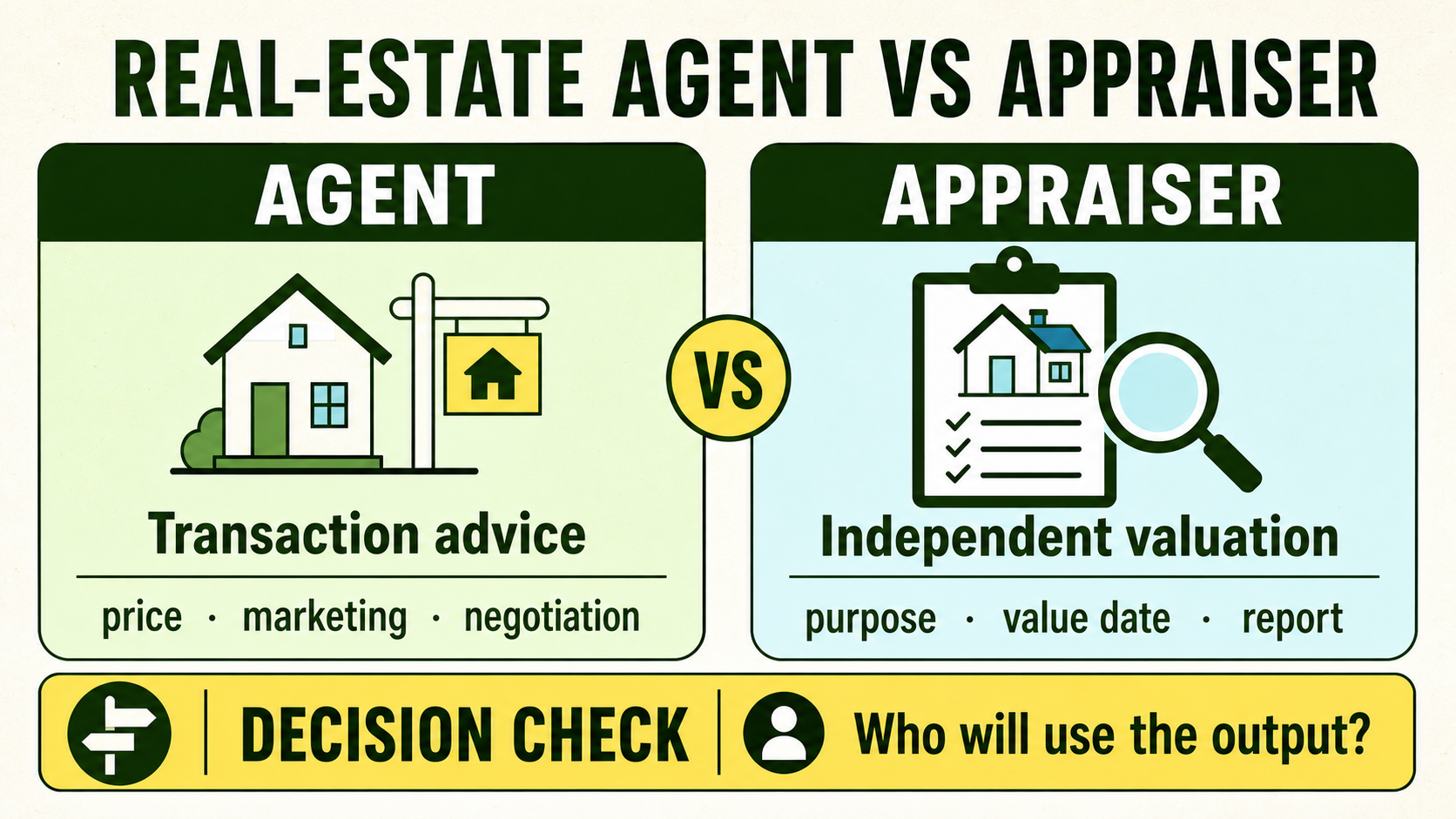
Choose an agent for transaction advice, marketing and negotiation; choose an appraiser when a lender, court, authority or another recipient needs an independent valuation report. One firm may offer both services, so ask which role applies to the output you need.
The assignment determines the distinction more than the person’s job title does. NVM’s 2026 consumer conditions for brokerage describe the makelaar as acting for a client and the taxateur as estimating and reporting value impartially. The exact report and acceptance conditions still come from the recipient.
Once you name the decision, the rest of the valuation becomes easier to follow.
At a glance
Real-estate agent
- main job: represent a buyer or seller in a property transaction.
- Typical work: price guidance, marketing, viewings, negotiation and transaction support.
- Main question: how should this transaction be prepared and handled for the client?
- Output: advice, listing material, negotiation support or transaction documents.
- Interest: acts for the client within the agreed brokerage assignment.
Registered appraiser
- main job: estimate and report a property’s value for a defined purpose and date.
- Typical work: inspect the property, study rights and characteristics, assess market evidence and write a reasoned report.
- Main question: what is the value under the stated assumptions, purpose and value date?
- Output: a valuation report that may be accepted by a lender or another recipient when it meets that recipient’s conditions.
- Interest: must work objectively and independently within the professional rules that apply to the assignment.
This comparison is a starting point. A person or firm can offer both services. Ask which service is being delivered, who signs it and who may rely on it.
A practical role check
The visual separates the transaction question from the independent-report question. Start with the person or organisation that will use the output.
What the real-estate agent does
The agent’s work is transaction-led. For a seller, that can include a price indication, marketing plan, viewings and negotiations. For a buyer, it can include search support, advice during viewings and negotiation on the purchase terms. NVM’s consumer conditions describe these activities as part of a brokerage assignment.
An agent’s expected sale price can be useful when setting an asking price. NRVT’s registration rules for appraisers draw a boundary between an indication made as part of acquiring a brokerage assignment and a professional valuation service. A price discussion for a listing should not be presented as a substitute for a lender’s independent report.
The agent also sees information through the lens of the client’s decision. That is appropriate for advice on a transaction. It is different from a report that must explain a value opinion to a recipient who expects independence.
What the registered appraiser does
The appraiser starts with the purpose, recipient and value date. The assignment may require an inspection, property and title information, comparable transactions, planning information, leasehold details, energy evidence or other documents. Your report should show how the evidence supports the value conclusion and which assumptions limit its use. Residential valuation basics provide the shared evidence framework behind that work.
Registration is personal. NRVT information about registered appraisers identifies what the register can verify and what it cannot prove about one assignment. Registration does not automatically confirm a fee, delivery date, experience with a special property or acceptance by a particular lender.
NRVT’s guidance on objectivity and independence explains why both actual independence and the appearance of independence matter. The rules require the appraiser to work autonomously and to refuse an assignment when a threat to independence cannot be removed. Ask how a possible prior brokerage or advisory role is handled before you order a report.
Which professional fits the situation?
You are selling a home
Start with a real-estate agent if your immediate task is setting an asking price, presenting the property, finding buyers or negotiating. Seller preparation connects those tasks to the information needed for a sale. Ask separately whether a lender, tax authority or legal process also requires a formal valuation report. If it does, request that service from an appraiser who meets the recipient’s conditions.
If you are preparing to sell, test your asking-price assumptions with a valuation before selling before choosing how to market the home, while keeping the brokerage role separate from the valuation assignment.
You are buying a home
A buyer’s agent can help you assess the transaction, negotiate and manage purchase questions. A registered appraiser can provide value evidence for the mortgage or another defined purpose. Buyer preparation connects the purchase decision to the property file, while valuation report requirements define the report’s purpose and intended user.
The two services answer different questions. A buyer’s agent can advise on a bid because of competition and negotiation. An appraiser does not act as your negotiator when writing an independent report.
You are arranging a mortgage or refinancing
The lender’s checklist sets the first control. Ask whether it accepts a physical report, a hybrid valuation or another method, which validation is needed and how recent the value date must be. Mortgage valuation report requirements identify common triggers, but the lender’s current instruction controls your application.
For an NHG case, the 2026 Q&A says a physical valuation report must meet independence conditions and may be no older than six months at the relevant point. Number: six months. Context: a physical valuation report in the NHG 2026 rules. Comparison: this is narrower than a rule for every lender or every report type. Explanation: the recipient needs evidence that still reflects the relevant property and market position. Implication: confirm the age limit with the lender before scheduling the inspection. A report prepared for a different purpose may not be reusable.
You are planning improvements
An agent can advise on market presentation and likely buyer questions. An appraiser may be needed when a lender wants a current value or a value after planned work. A building inspector or contractor may be needed for technical condition and costs. Keep those scopes separate when you collect documents.
Here is why the distinction matters when you are arranging the report.
Why an appraiser’s report is not a building inspection
A valuation inspection gathers facts that affect value. A valuation inspection gathers value-related facts; a building inspection may be needed for defects, installations or construction detail. If you need technical assurance, ask for a building inspection and check what that report covers. If a lender asks for both documents, one should not be assumed to replace the other.
The same distinction applies to negotiation advice. A report can identify a condition that affects value, while an agent can help decide how that condition affects a bid or sale strategy. The person who reports the value is not automatically responsible for every purchase risk.
When the roles sit in one firm
A firm may offer brokerage and valuation services under one roof. That fact alone does not answer whether a particular report is suitable. Check the following:
- Who is the contracting party for the valuation?
- Who will inspect, write and sign the report?
- Has that person or firm already represented a buyer or seller in this transaction?
- What does the recipient require about registration, validation, method and report age?
- How is the fee set, and is it independent of the estimated value?
NVM’s consumer conditions state that a valuation fee may not depend on the estimated market value. That rule is different from the fee arrangement for brokerage work, which is agreed for the brokerage assignment. Compare scope and conditions before comparing totals.
A simple decision matrix
Use the first matching task as your starting point:
Set an asking price or sales plan
Start with a real-estate agent. Ask how the price indication was formed and whether you also need a separate independent report.
Negotiate a purchase or sale
Start with the agent who represents your interests. Keep any lender valuation and negotiation advice as separate documents with separate purposes.
Give a lender independent value evidence
Start with a registered appraiser. Confirm the lender’s accepted method, validation, report age and submission process first.
Check technical condition
Start with a building inspector or the relevant technical professional. A valuation report is not a general defect survey.
Check a municipal WOZ position
Start with the municipal decision, value date and property facts. A private valuation may answer a different question, so state the purpose before commissioning one.
Challenge the simple answer
The roles are separate, yet real work can overlap. Some professionals hold both a brokerage role and an appraisal registration. A price indication can be carefully reasoned, and an appraiser may understand negotiation pressures. Neither point changes the purpose of the document or the independence question for a specific assignment.
Lenders can also accept different valuation methods in different cases. A physical report, hybrid product or model-based valuation may each have a place under current policy. NHG and lender conditions can change. Treat the recipient’s written instruction as the controlling evidence.
Questions to ask before you order
- What decision will this work support?
- Who will receive and rely on the document?
- Is the requested output a price indication, brokerage advice, valuation report or technical inspection?
- Which registration, validation and method does the recipient accept?
- What value date and maximum report age apply?
- Has the provider or firm had another role in the same transaction?
- What is included in the fee, and when will the signed output arrive?
Keep like-for-like provider answers together in comparing property valuers, alongside the lender’s message, the quote and the final assignment.
A provider screen should test appraiser independence, interpret appraiser reviews and avoid common selection mistakes. A purchase-specific brief can then name an appraiser for buying a home.
A seller who needs independent market-value evidence can frame the assignment through an appraiser for selling a home. This keeps the valuation question separate from an agent’s asking-price strategy.
Use these questions to test whether the proposed work fits your situation.
FAQ
Can a real-estate agent also be an appraiser?
One person can hold both roles. The service still needs its own purpose, scope and independence assessment. Check the person’s registration and ask who will sign the report before treating it as professional valuation evidence.
Is an agent’s price indication enough for a mortgage?
Do not assume that it is. Ask the lender which document and method it accepts. A brokerage price indication and an independent valuation report answer different questions.
Do I need both an agent and an appraiser?
You may need both when a transaction requires negotiation or marketing as well as independent value evidence. The need depends on the decision, recipient and lender conditions.
Is a registered appraiser impartial in every situation?
The professional rules require objectivity and independence for the valuation assignment. Registration does not remove the need to check conflicts, prior involvement, purpose and recipient conditions.
Can an appraiser tell me whether to make an offer?
The report can provide value evidence within its stated purpose. An agent or adviser can help with negotiation and transaction strategy. Ask each professional to describe the boundary of the service you are buying.
Next step
Write down the decision, recipient, value date and document needed. Then compare providers on the same brief. Comparing property valuers keeps the answers aligned, while the report, mortgage and preparation questions should remain tied to the case.
A broker's transaction advice and an appraiser's independent report serve different purposes, even when one firm offers both. Ask who will use the output and what must be signed or accepted.
Ask about the agent or appraiser choice →