What Is an NRVT Appraiser?
Learn what the Dutch NRVT register means, how its four chambers and 2026 education rules work, and what registration does not tell you about one assignment.

When this valuation matters
If you are checking a property appraiser, use the NRVT register to confirm whether the person is listed and under which chamber. Buyers, homeowners, lenders and advisers can check that status and then ask about experience, scope, timing and acceptance.
TL;DR
An NRVT appraiser is a property valuer registered personally in the Dutch Register of Property Valuers. Check the relevant chamber and active status, then ask whether the person fits your property, purpose and report recipient.
The register is useful evidence when you check a provider. It does not tell you the fee, delivery date, lender acceptance, exact experience with your property or likely value. Confirm the person, chamber, assignment and recipient conditions separately.
With the situation clear, start by separating the property facts from the decision the report must support.
NRVT registration identifies the professional framework. When you assess a specific property, match property valuation evidence from Waalre to the property facts that the report must address.
What NRVT records
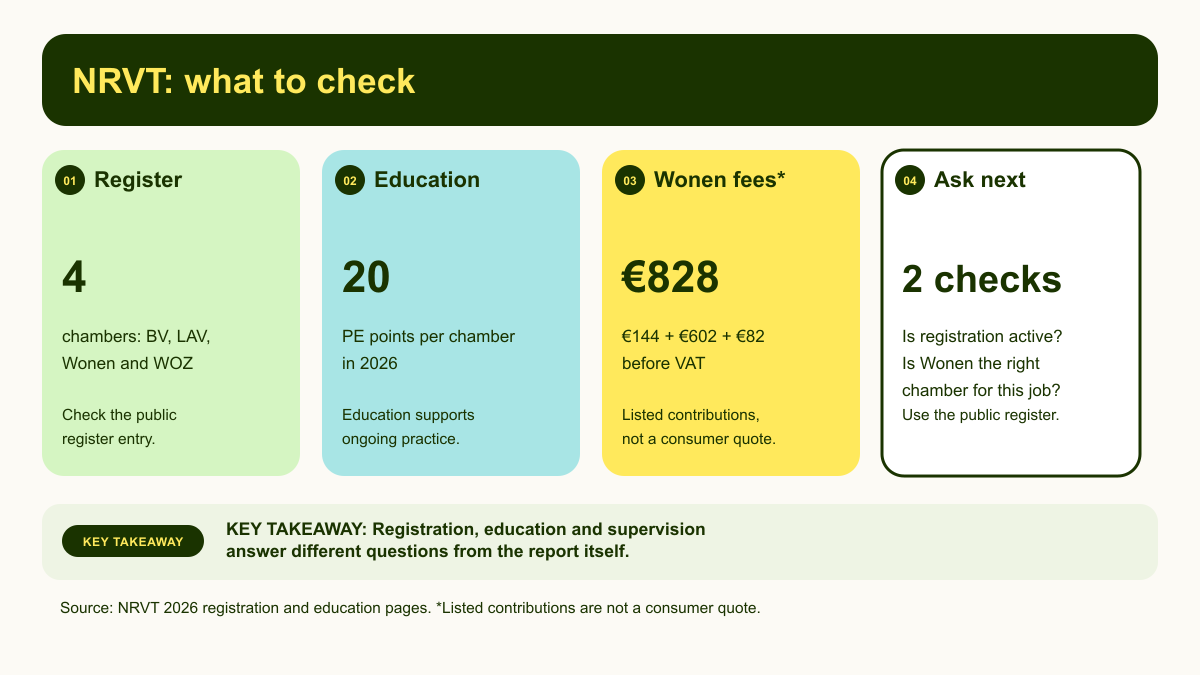
NRVT’s public FAQ says registered valuers are recorded personally and placed in chambers for their work areas. The four chambers are Business Real Estate, Rural and Agricultural Real Estate, Wonen and WOZ. The Business Real Estate chamber also has a Large-Scale Business Real Estate annotation.
For a residential mortgage or home sale, the Wonen chamber may be the relevant starting point. The correct chamber still depends on the assignment. A name that appears in a register is not enough when the property or purpose falls outside the person’s work area.
Registration is only one part of comparing property valuers. The boundary between brokerage advice and an independent report is set out by real-estate agent versus appraiser.
What registration involves
NRVT describes admission requirements, professional rules, practice guidance, education and continuing supervision. The register creates a public way to check a person’s status and work area. The rules set expectations for professional conduct, independence and the way a valuation is prepared.
Education is a live requirement. NRVT’s 2026 education page sets a minimum of 20 permanent education points per chamber. Registration in an extra chamber adds 6 points per extra registration. This is a professional-maintenance rule, not a rating of the valuer’s work on your home.
The NRVT 2024 annual-report summary gives organisation-level figures: 87.2% of registered valuers met the permanent-education obligation, 195 new trainees started the master-apprentice path, 49 disciplinary complaints were filed by NRVT and 58 disciplinary procedures started. These figures show the scale of the framework in that reporting year. They cannot grade an individual report.
The 2026 contribution figures
NRVT’s registration page lists these 2026 amounts, all excluding 21% VAT:
- registration contribution for a valuer: €144;
- Wonen or WOZ chamber contribution: €602;
- tucht contribution: €82.
The three listed Wonen lines add up to €828 before VAT. If 21% were applied to every line, the arithmetic would be €828 × 1.21 = €1,001.88 including VAT. This is an arithmetic illustration of the published ex-VAT amounts, not a consumer valuation fee. A provider’s invoice and tax treatment should be checked directly.
What continuing supervision means
NRVT explains that continuing supervision looks at how a valuer reached an opinion and whether the rules and guidance were followed. It does not judge the outcome alone. An audit can start with a desk review of files and reports, followed by a deeper field audit when the first review raises questions. An annual self-declaration is also part of the process described by NRVT.
The supervision page says most audits finish without a follow-up. Where the rules were not followed, NRVT can issue advice or an instruction, and may file a disciplinary complaint depending on context and seriousness. This describes the regulator’s process. It does not mean every registered valuer has the same availability or experience.
What the register does not answer
Check these questions with the provider and report recipient:
- Does the person work in the Wonen chamber for this property and purpose?
- Is the registration active on the day the assignment is accepted?
- Is the lender asking for a validated report or a particular method?
- Has the person handled leasehold, rental, unusual construction or a homeowners’ association issue before?
- Who inspects, who writes, who signs and who answers a correction request?
- What is included in the fee and when is the report delivered?
These questions convert a register check into an assignment check. The remaining evidence belongs in valuation quote comparison alongside scope, method, timing and recipient conditions.
Keep the register check connected to appraiser independence and conflicts, appraiser reviews and ratings and common selection mistakes. Buyers can turn that status into a purpose-specific brief through an appraiser for buying a home.
NRVT and NWWI are different
NRVT registers and supervises people who carry out property valuations. NWWI is a validation institute that checks residential valuation reports through its own process. A report can involve both a registered valuer and validation, yet the two names describe different roles.
For a mortgage with NHG, NWWI validation and NHG valuation requirements form separate parts of the application. The lender’s current conditions decide what the application needs.
A careful verification script
Use this wording in an email or call:
Please confirm your active NRVT registration, the chamber relevant to this assignment, the proposed report method, validation status, fee including VAT, inspection date and delivery date. The lender has asked for [recipient condition], and the property has [special feature].
The written answer gives you a record of what was understood before work begins. Save it with the quote and documents.
Before the appointment, settle the practical questions that affect the report.
FAQ
Does NRVT registration guarantee a high valuation?
No. Registration shows that the person is in the professional register and subject to its framework. It does not promise a particular value, result, price or lender decision.
Is every NRVT appraiser suitable for a home valuation?
Check the relevant chamber, property type, assignment purpose and recipient conditions. Wonen is the residential chamber, yet the report still has to match the lender or other recipient’s requirements.
Is the €828 NRVT figure a consumer valuation fee?
No. It is the sum of three 2026 Wonen registration lines listed by NRVT before VAT: €144 registration, €602 chamber and €82 tucht. It describes professional contributions, not what a consumer pays for a valuation.
Registration can help confirm a professional's status, but it does not confirm availability, assignment-specific independence or lender acceptance. Check the register and the recipient's rules.
Ask about an NRVT question →