Appraiser for Divorce and Asset Division: How to Prepare
Learn how a property valuation can support a fair discussion about a shared home during separation, and which legal and financial questions need separate advice.

When this valuation matters
If you are dividing property after separation, keep ownership, debt, tax and family arrangements in their proper conversations. Co-owners, lawyers, mediators and advisers need a common property reference for a sale, buyout or settlement while keeping ownership, debt, tax and family arrangements with the right professionals.
If one property may need a report for both a buyout and refinancing, using one appraiser for multiple purposes requires the purpose, recipient and value date to be separated before one appointment is reused.
Table of contents
- TL;DR
- What an appraiser can clarify
- Why the purpose and value date matter
- Facts that shape asset division
- A neutral valuation path
- Common mistakes and edge cases
- FAQ
TL;DR
An independent valuation can give separating co-owners the same reference point for the home. Agree the purpose, value date and recipient before the visit, and let the report answer the property question without asking it to decide the settlement.
Agree the question before the inspection. Write down who will use the report, whether the home may be sold or transferred, which value date applies and which documents are available. Ask the lawyer or mediator whether the report needs a particular wording or recipient. Ask the lender separately about financing and release from liability.
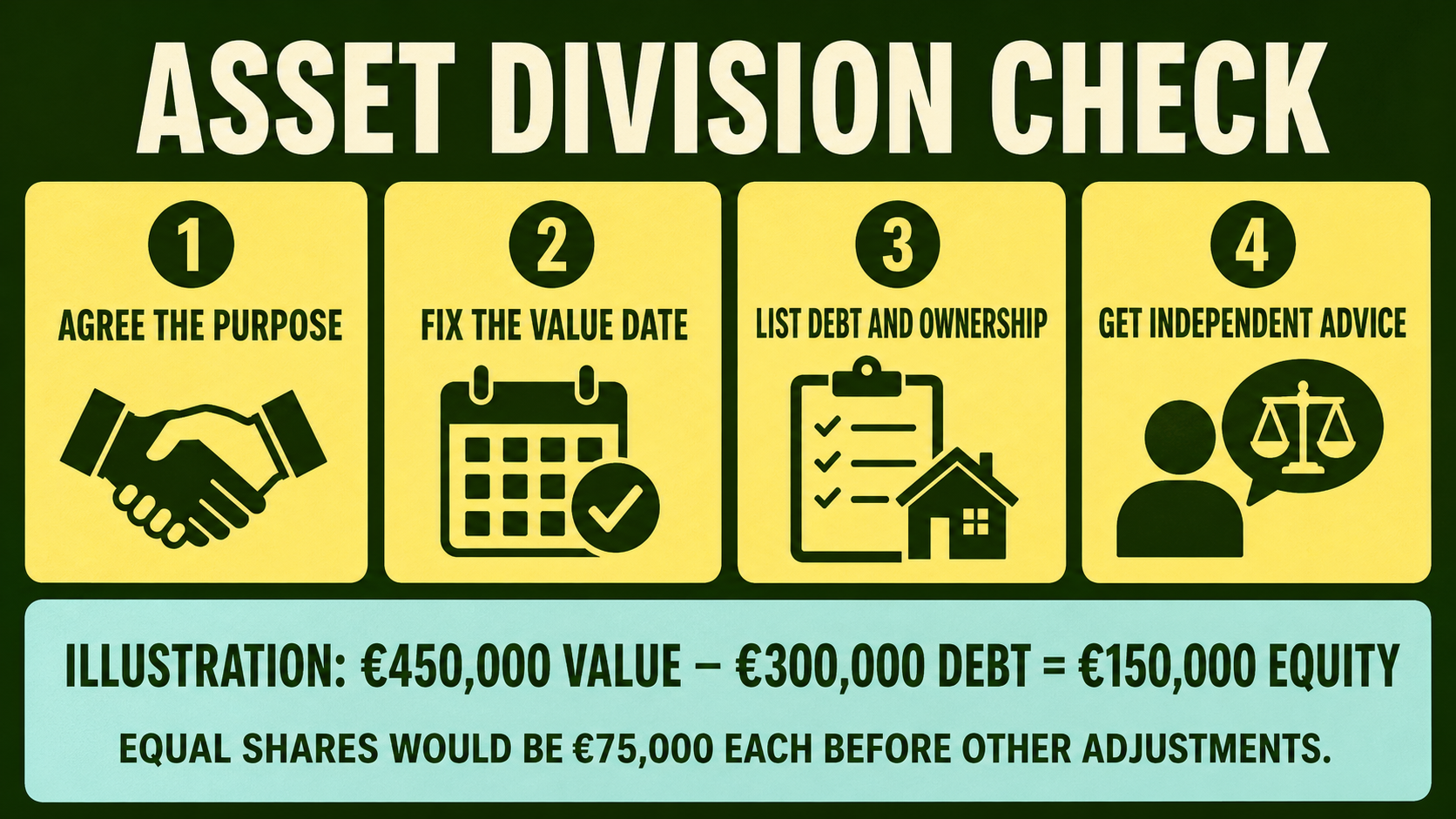
For orientation, an illustrative €450,000 value minus €300,000 debt leaves €150,000 of equity. Dividing that illustration equally gives €75,000 each before ownership percentages, costs, tax, other assets, contributions and settlement terms. The arithmetic explains a concept. The calculation is illustrative; the legal and tax result needs professional review.
Once you name the decision, the rest of the valuation becomes easier to follow.
When you divide property after separation, compare local residential market evidence from Sterksel with the property records, while ownership and division questions remain explicit in the brief.
What an appraiser can clarify
A property appraiser can form and report a value opinion for a defined date and assignment. The evidence can include the home’s physical condition, floor area, improvements, location, comparable transactions, legal or leasehold information and stated assumptions.
That opinion can help the parties discuss a sale, a transfer to one owner or another value question. It does not replace the work of a lawyer, mediator, notary, mortgage adviser or tax adviser. Rijksoverheid’s separation guidance points to legal help with agreements about money, the home, debts and taxes. Keep those decisions with the appropriate professional.
When one party suggests a provider or the appraiser has had earlier involvement, appraiser independence and conflicts of interest should be addressed before a shared appointment. A shared report is more useful when the parties understand the appointment and reliance conditions.
Now the practical consequence becomes clear: the evidence has to answer the question behind the assignment.
Why the purpose and value date matter
The value can be needed for a sale, transfer, refinance, mediation, court process or a private negotiation. Each context can ask for a different definition, report format or recipient. A report prepared for one purpose is not automatically suitable for another.
The value date is especially important when the separation, move, agreement or court step happened at a particular time. Property condition, work, market evidence and debt can change after that date. Record the date in the instruction and ask whether a later report or update is needed.
The NRVT definition of market value assumes willing parties, proper marketing and no compulsion. A forced sale or a private transfer may require an adviser to explain whether the standard market-value question fits the decision.
Facts that shape asset division
Market value
Market value is an estimated value under stated market assumptions. It does not determine the agreed transfer price or how a settlement allocates value between parties.
Equity
Equity is commonly discussed as value less relevant debt. The debt figure can need confirmation from the lender, and the division can also depend on ownership, agreements, tax, costs and other assets.
Ownership and liability
Ownership shares and liability for a mortgage are separate questions from the appraiser’s value opinion. Ask the notary, lawyer and lender how they affect the proposed arrangement.
Value date
The value date anchors the reported opinion. It should match the question set by the parties or their adviser, not simply the day someone books an inspection.
Independence and assumptions
An independent appraiser should disclose relevant involvement and assumptions. Share the same property facts with both parties and record missing information instead of filling gaps with estimates.
Questions that belong with this decision
Different value concepts need different definitions, so market value, foreclosure value and WOZ value should not be exchanged casually. Valuation report validity also depends on purpose, date and recipient rather than age alone.
A shared evidence file needs property valuation documents that both parties can trace. A sale introduces selling valuation as a separate purpose, while an inheritance can require inheritance valuation with its own date and evidence.
A neutral valuation path
1. Agree the purpose
Ask the lawyer, mediator, notary or other responsible adviser what decision the report must support. Name the expected users and whether the property may be sold, transferred or refinanced.
2. Fix the value date
Record the agreed date and the reason for it. Ask the provider how the report handles work completed, market evidence and documents that relate to another date.
3. Assemble property and debt facts
Collect title or ownership information, the mortgage balance from the lender, plans, permits, leasehold or homeowners’ association documents, energy evidence, invoices, defects and planned work. Give both parties the same factual base where appropriate.
4. Choose an independent report process
Ask about earlier involvement, the report recipient, valuation definition, inspection, assumptions, validation and delivery. If a court or lender is involved, confirm its current requirements before commissioning the report.
5. Review the opinion with the right adviser
Check the property identity, value date, purpose, debt figure used, assumptions and conclusion. Ask the lawyer, mediator, notary, lender or tax adviser how the value fits the broader decision. Do not treat the reported value as the settlement itself.
Keep these points in view when you ask for the report.
Before you book, check the mistakes that can create extra work or leave you with the wrong report.
Common mistakes and edge cases
Using an asking price as the agreed value
An asking price is a marketing choice. It can be evidence to discuss, but An asking price may differ from an independent market-value opinion.
Dividing equity without checking ownership or debt
The illustrative €75,000 each does not account for ownership shares, contributions, arrears, costs, tax, other assets or agreements. Have the responsible adviser calculate the actual settlement.
Choosing a provider who worked for one party
Earlier advice, brokerage, inspection or valuation can create a perceived or actual conflict. Ask for disclosure and consider a jointly accepted independent method.
Ignoring improvements or defects
Record work completed, work planned and known defects. A future scenario needs a clear specification and assumptions.
Treating a report as a legal conclusion
A valuation does not decide entitlement or mortgage release. Keep legal, tax and financing questions with the relevant professionals.
If cost, timing or acceptance still concern you, ask the provider to state each condition before the appointment.
FAQ
Is a valuation required in every divorce?
No single rule applies to every separation. The parties or their advisers may need a valuation for a sale, transfer, refinance or settlement discussion. Ask the responsible adviser what evidence is needed.
Who should order the report?
The person or parties who need to rely on it should agree the provider, purpose and recipient. A lawyer, mediator or lender can add requirements.
What is home equity?
As a simple illustration, it is the home’s relevant value minus relevant debt. Rijksoverheid uses that definition in a benefits context. Actual division can include ownership, agreements, costs, tax and other assets.
Can an appraiser decide who gets the home?
No. The report can provide value evidence. Ownership, transfer, financing and settlement decisions belong to the parties and their legal, notarial, mortgage or tax advisers.
Can an old valuation be reused?
Only if the intended recipient accepts its purpose, value date, report age and evidence. A report is reusable only when those conditions still fit; valuation report validity tests them rather than age alone.
A neutral valuation can create one shared reference point, but it does not decide who owns the home or how a settlement should be structured. Agree the purpose and value date with the other party and your lawyer or mediator, then share complete property and debt information. Contact us if you want to check the valuation questions before an appointment.
Ask about a neutral home valuation →