How Long Is a Property Valuation Report Valid?
Find out how report age is measured in Dutch mortgage cases, why six months is not a universal rule and what to check before reusing a valuation.

When this valuation matters
If you are reusing a valuation report, check its date, purpose and recipient before relying on it for a new decision. Homeowners, buyers, lenders and advisers can use this guidance before reusing an older report for a new decision.
TL;DR
Check the value date, delivery deadline, report method, property changes and new recipient before reusing a valuation report. A lender may apply an age rule, while another purpose can require a new assignment even when the home has not changed.
Check four things before relying on an existing report: the value date, the report purpose, the intended recipient and any changes to the property or loan. Ask the lender or other recipient for written confirmation when the timing is close.
With the situation clear, start by separating the property facts from the decision the report must support.
When you prepare a mortgage file, compare the report date, recipient and financing assumptions with the lender’s mortgage questions before an offer.
“Valid” has more than one meaning
People use valid to mean that a report is complete, professionally signed, still factually useful or accepted by a particular organisation. Those are different tests. A report can remain a real document while failing the recipient’s current age or purpose requirement.
For a mortgage file, identify these dates:
- Value date: the date to which the market value applies.
- Inspection date: when the property was observed, if there was a physical visit.
- Report date: when the written report was completed or signed.
- Delivery date: when the lender received it.
- Use or offer date: when the lender checks the document in the application.
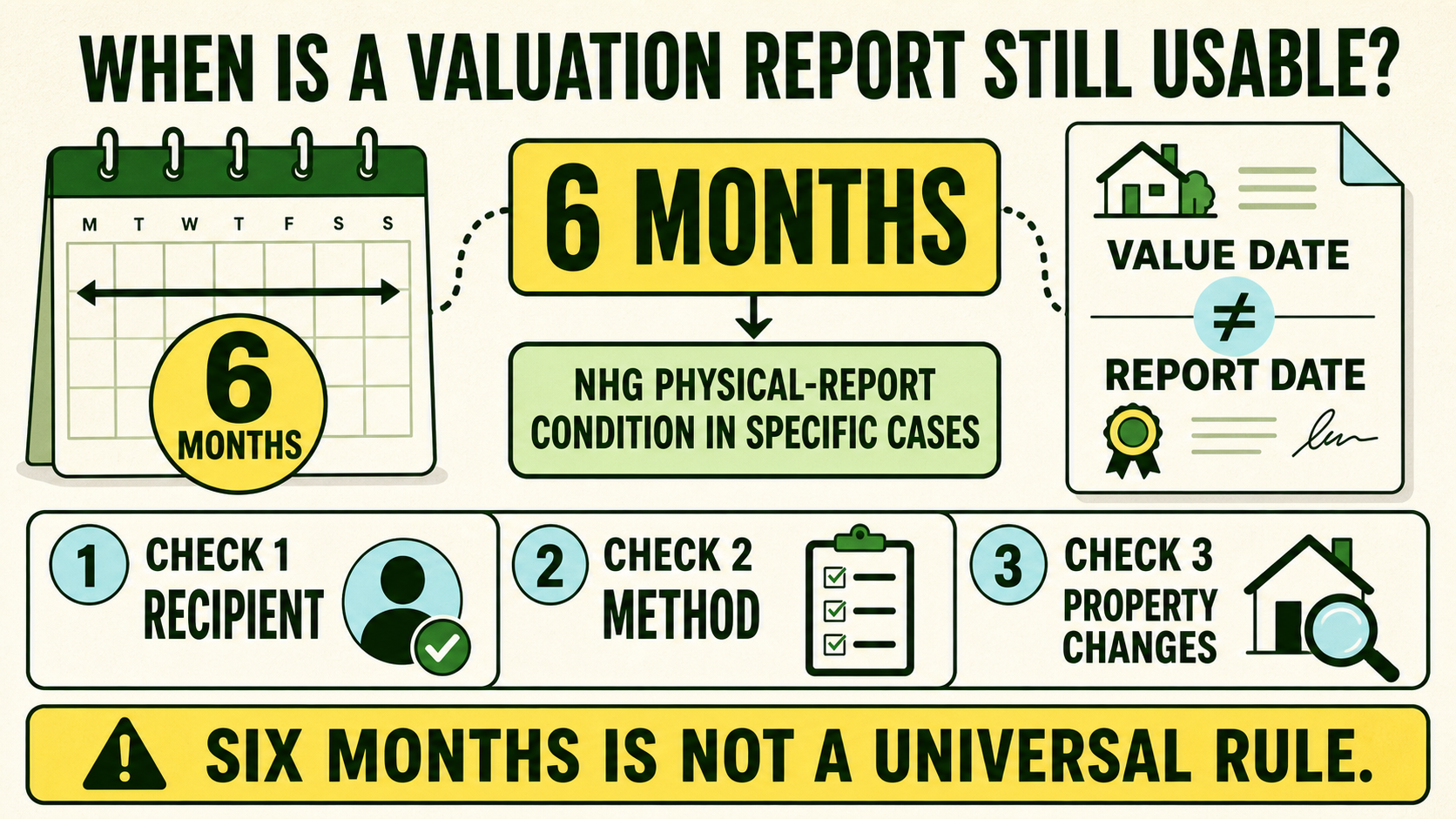
NHG’s six-month condition is measured from the value date in the cited mortgage context. Do not assume that the signature date is the starting point. The purpose and intended user belong in valuation report requirements before the age of a document is assessed.
The six-month rule in context
Number: six months. Context: the NHG 2026-1 requirements for relevant physical and approved hybrid mortgage valuations in the Netherlands, measured from the value date. Comparison: this is narrower than an expiry rule for every lender, report type or private decision. Explanation: the recipient wants evidence that remains linked to the property and market position at the required point in the application. Implication: check the current lender deadline before reusing a report or booking a new inspection.
Illustrative date arithmetic:
- value date: 12 March 2026;
- six calendar months later: 12 September 2026;
- practical question: must the lender receive and use the report before that date, or earlier under its process?
The arithmetic shows how to start the check. The lender’s written instruction, the applicable NHG version and the report conditions decide whether the report is accepted through 12 September.
NHG’s six-month physical valuation requirement applies in the stated NHG context. The NHG Conditions and Standards 2026-1 provide the wider rules and should be checked against the version governing the file.
What can change between the report and the application?
Age is only one risk. Ask whether any of the following changed:
- the purchase price, loan amount or mortgage purpose;
- the ownership, leasehold or rights attached to the home;
- the layout, condition, permits or planned improvements;
- the energy works or value after completion;
- the lender, validation method or intended report user;
- the property market in a way that makes the old evidence less useful;
- the document’s signature, validation or required attachments.
A new mortgage can need a fresh report even when the property looks unchanged. The application may use a different recipient, product, loan-to-value calculation or report format. Mortgage valuation report requirements keep the trigger and accepted method together.
Does the rule differ by mortgage situation?
It can. A purchase, refinancing, mortgage increase, bridge loan and renovation loan can have different file instructions. NHG conditions add another layer when the guarantee applies. The fact that one bank accepts a six-month-old report for one product does not prove that another bank or product will accept it.
ABN AMRO and Rabobank both explain a six-month report-age example in their public mortgage information, alongside their own method and acceptance details. Treat those pages as examples of lender policy, not as a universal bank rule. Ask the actual lender:
- Which value date starts the age calculation?
- Must the report be received, assessed or used before the deadline?
- Is a physical, hybrid or another method accepted for this purpose?
- Is validation required, and which institute is accepted?
- Does the report need to come from the lender’s approved system?
Keep the answer with the valuation assignment. Policies and product pages can change.
Physical and hybrid reports
NHG’s 2026-1 material covers both physical reports and approved hybrid valuations in its relevant mortgage rules, with method-specific conditions. A physical report involves an inspection. A hybrid valuation uses a model value assessed by a registered appraiser at a distance. Online and physical valuation must be assessed against method, purpose and age together.
NRVT’s current FAQ says hybrid valuation is intended for obtaining, refinancing or adjusting a mortgage or bank loan monitoring. It excludes purposes such as inheritance, tax and division of an estate. A six-month mortgage rule so does not turn a hybrid report into a general-purpose report for a different decision.
When you may need a new report
Request a new report, or ask the recipient for its documented process, when:
- the six-month point has passed or is too close for the lender’s delivery schedule;
- the report was commissioned for another recipient or purpose;
- the property has changed materially;
- the loan now includes improvement or energy work;
- the value date no longer represents the required decision point;
- the lender cannot confirm acceptance of the old method or validation;
- the report contains a condition that requires a new inspection or document.
Do not order automatically if the issue is only uncertainty about the date. First ask whether the existing report can be used and what deadline applies. This can prevent paying for work that the recipient would not have required.
With the purpose settled, you can work through the checks in an order that mirrors the decision.
Reuse checklist
Open the report and record:
- value date;
- inspection date and report date;
- named purpose and intended users;
- property address and legal description;
- method, signer and registration details;
- validation institute and validation date, if applicable;
- current lender, mortgage product and delivery deadline;
- changes to the property, loan or planned works.
Then send those facts to the lender or adviser. Property valuation documents show which supporting records are complete and which are missing. If the answer is “new report,” ask which items changed the decision before requesting a quote.
Challenge the simple answer
“Six months means every report is valid for six months” is wrong. The figure belongs to a defined NHG mortgage context and may be applied with lender deadlines, method conditions and purpose restrictions. A report can be younger than six months and still be rejected for the wrong recipient or purpose.
“An old report is useless” is also too broad. For a private orientation, an older report can still explain earlier evidence. It may help you understand the property history or prepare questions. That usefulness is different from acceptance in a new mortgage file.
Market movement creates another uncertainty. A report can be within the stated age limit while a material change in the home, rights or financing makes its assumptions obsolete. Ask the recipient rather than treating calendar arithmetic as a substitute for review.
Use these questions to test whether the proposed work fits your situation.
FAQ
Is a valuation report always valid for six months?
No. Six months is the cited NHG mortgage condition measured from the value date in the relevant context. The lender, purpose, report method and current rules can create a different requirement.
Does the six months start on the report date?
Not necessarily. NHG’s cited condition measures age from the value date. Record both dates and ask the recipient which deadline applies to delivery and use.
Can I reuse a report for a different lender?
Only if the new lender confirms that it accepts the report, method, validation, purpose and age. A report prepared for one recipient is not automatically transferable to another file.
Does a renovation reset the report’s validity?
No. A renovation can change the value question and the required method. Ask whether the lender needs current value, value after improvement or a new inspection.
Is a hybrid report subject to the same six-month rule?
NHG’s 2026-1 material gives an age condition for approved hybrid valuations in the relevant mortgage context. The product must still be accepted and hybrid valuation is not a general-purpose substitute for every report.
The six-month condition discussed here is not a universal expiry date. Check the value date, lender, method, property changes and current recipient rules before reuse.
Ask about report validity →