Appraiser Independence and Conflicts of Interest: What to Check
Learn how independence and conflicts of interest affect a Dutch property valuation, what NRVT rules require and which questions to ask before ordering a report.

When this valuation matters
If you need a valuation that a lender, court, family member or business partner can trust, ask about independence before commissioning it. Buyers, owners, lenders, lawyers and advisers can ask about prior roles, pressure and relationships before the report is commissioned.
TL;DR
Ask how the appraiser will handle prior advice, brokerage work, personal ties or pressure from an interested party. Independence belongs to the assignment and the way the report is formed, so a title or register entry alone cannot answer the whole question.
NRVT rules give the appraiser the professional duty to assess threats to objectivity and independence. That duty belongs to the appraiser, while a client can make the check easier by describing the purpose, recipient and parties at the start. Choosing a property valuer connects that check to the wider selection process.
That gives you a useful starting point. The next question is how the assignment works for the person who will rely on it.
When you assess an appraiser’s independence, compare a residential valuation in Veldhoven with the assignment’s property evidence, then ask whether the appraiser can assess that evidence without conflicts.
Why independence matters to a valuation report
A valuation report may be used by a lender, court, tax authority, buyer, seller or another decision-maker. Those readers need an opinion that is formed for the stated purpose and can be explained from the evidence. A report can lose practical value when the reader reasonably suspects that the appraiser was pulled toward an outcome.
Independence has two sides. The first is the appraiser’s actual freedom to form a view. The second is the appearance of freedom to an informed reader. NRVT guidance treats both as relevant. A personal relationship, a previous brokerage role or a financial connection can matter even when nobody admits to changing the number.
The purpose of the report sets the frame. A broker may advise a client about an asking price or a negotiation. An appraiser prepares an independent value opinion. Agent versus appraiser roles stay distinct even when one person or firm offers both services.
With the purpose settled, you can work through the checks in an order that mirrors the decision.
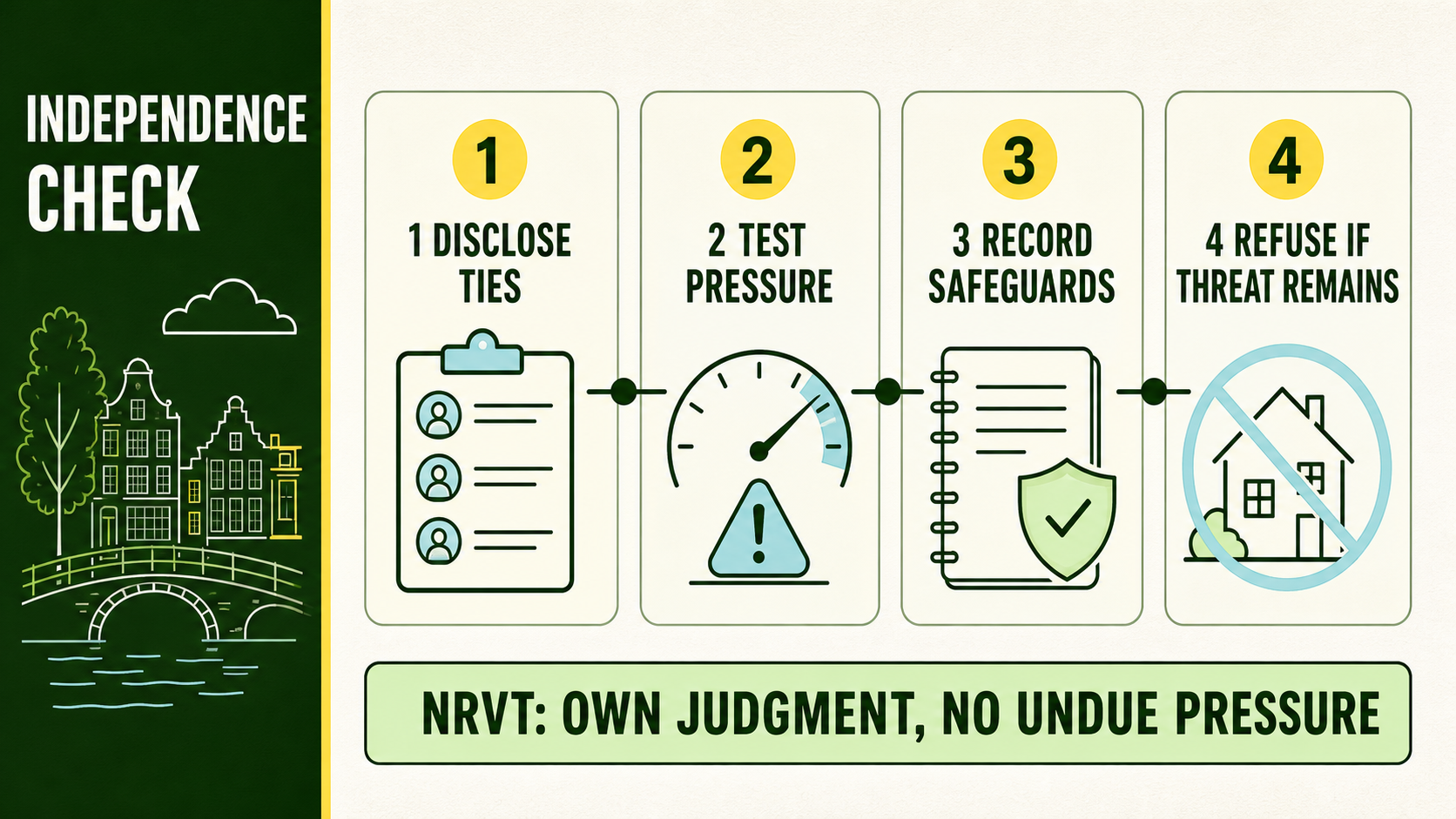
The independence model in four checks
1. Disclose ties before the assignment
Tell the provider who is involved, which property is being valued and what earlier work has taken place. Ask the provider to check the property, the client, the broker, the lender and the employer or firm for relevant connections.
Previous involvement does not create an automatic answer in every case. NRVT guidance says it must be considered and explained. Early disclosure gives the appraiser a chance to accept with a documented safeguard or return the assignment before time and money are spent.
2. Test for pressure or a value instruction
There is a difference between supplying facts and asking for a result. A floor plan, repair invoice or comparable sale helps the valuation when its reliability and relevance can be assessed. A request to make the value reach a predetermined amount is a value instruction and puts the professional judgment under direct pressure.
Ask what happens when the evidence points below the hoped-for value. A provider should be able to say that the evidence controls the conclusion and that the assignment will be declined or returned when pressure cannot be removed.
3. Record safeguards in the file
An appraiser can sometimes manage a potential threat by disclosing the connection, separating roles, adding an independent review or explaining the situation in the report. The safeguard must fit the threat. A friendly explanation cannot cure a financial interest that still depends on the transaction succeeding.
For a client, the useful question is simple: which fact created the concern, what measure removes it and where will that measure be recorded? Written answers also create a clear handover if the lender or another recipient asks later.
4. Refuse when the threat remains
NRVT Article 11 says the assignment should be refused or returned when a threat cannot be prevented or removed. This is a quality signal. A provider who says no to an unsuitable instruction protects the usefulness of the report, even when that creates a short delay.
Previous involvement, relationships and financial interests
Look at the connection from four angles:
- The property: the provider or a colleague may have advised, sold, managed, inspected or previously valued the home.
- The people: the provider may have a close personal relationship with a buyer, seller, broker or lender.
- The organisation: a firm may be involved in another service or may share a close business relationship with an interested party.
- The money: the provider or firm may depend heavily on one instructing party or may benefit from the transaction or the value outcome.
NRVT’s guidance gives a 25% turnover example. When one client structurally contributes more than 25% of the Dutch turnover of the appraiser or firm, the guidance says the appraiser should consider whether freedom to perform the professional valuation service remains. The number is a trigger for reflection in that guidance. The figure only prompts reflection; each assignment still needs its own review.
What a buyer or lender can check
Start with the provider’s professional status. NRVT explains that registered appraisers are recorded personally and can be found in its register. Registration tells you that the person is subject to the relevant professional framework. It does not prove that a particular report will meet every lender’s conditions or that the person has experience with a special property.
For an NHG physical report, NHG currently describes three separate conditions: independence of the maker, validation by an accepted validation institute and a maximum age of six months from the value date. The six-month rule belongs to the NHG condition described here. Confirm the current requirement with the lender or report recipient before ordering.
If validation is required, ask who will validate the report and whether the chosen method and property fit the recipient’s rules. NWWI validation defines the purpose of validation, while NHG requirements set the mortgage-specific context.
Red flags before you agree
Pause and ask for clarification when a provider:
- promises a value before seeing the evidence;
- asks what number is needed and presents that as the target;
- will not explain previous involvement with the property or an interested party;
- ties the fee to the value reached;
- cannot identify the report recipient or purpose;
- treats validation as an optional afterthought when the lender requires it; or
- says a low value will be changed because the client dislikes the result.
One awkward sentence is not proof of a conflict. Use the pattern, the facts and the provider’s response. If the answer remains unclear, a second provider can be safer than trying to repair a report after submission.
Questions to ask before ordering
Use these questions in an email or phone call:
- Who will sign the report, and in which professional register can I verify that person?
- Have you or your firm advised, sold, inspected, managed or valued this property before?
- Do you have a personal, business or financial connection with any party to the transaction?
- Who will receive the report, and which acceptance or validation conditions apply?
- What will you do if the evidence does not support the value I hope for?
- How will any disclosed threat and safeguard be recorded?
These questions supplement, rather than replace, the appraiser’s own professional assessment. Valuation quote comparison puts the answers beside scope, timing and fee information.
Local knowledge is a separate quality question
An appraiser’s knowledge of a neighbourhood can help with comparable evidence, property types and local market conditions. Local knowledge does not cure a conflict of interest. Treat it as a separate criterion after independence, purpose and recipient acceptance are clear.
The same separation helps when comparing providers across Dutch regions. A local office, a national platform and a specialist may each have a different process. Ask what evidence they use for this property rather than treating a postcode or brand name as proof of independence.
A balanced view of the check
The safest reading of independence rules avoids two shortcuts. A previous valuation does not automatically disqualify an appraiser in every situation, and a shared professional label does not automatically prove freedom from conflicts. The deciding facts include the role previously performed, the people involved, the timing, the financial links and the ability to form an autonomous opinion now.
The same caution applies to the 25% turnover example and the NHG six-month condition. One is a professional reflection signal. The other is a mortgage-program condition. Neither provides a universal answer for every lender, purpose or property. If the report will affect a high-stakes decision, record the recipient’s current requirements before you order.
Use these questions to test whether the proposed work fits your situation.
FAQ
Does NRVT registration prove that an appraiser is independent for my assignment?
Registration places the person within the NRVT framework. The particular assignment still needs its own independence assessment, including any earlier involvement, relationships and pressure.
Is a previous valuation of the same home always a conflict?
No automatic conclusion follows from that fact alone. The appraiser should disclose and assess the earlier involvement, the parties and whether an autonomous opinion can be formed now.
Can I tell the appraiser the value I need for a mortgage?
You can explain the financing purpose and the recipient’s conditions. Asking the appraiser to reach a chosen value is a value instruction and conflicts with an independent professional opinion.
What should I do when the provider cannot answer the independence questions?
Ask for a written explanation and check the recipient’s conditions. If the threat cannot be explained or managed, request the report from a provider without that connection.
Before ordering, describe the report's purpose and ask whether the appraiser or firm has any current or previous connection with the property, transaction or parties. A request to reach a chosen value deserves a clear refusal and, when needed, a different provider. Contact us if you want help turning your situation into a short screening question.
Ask about an independence check →