How to Read Property Appraiser Reviews and Ratings Reliably
Use a practical four-signal method to assess reviews of Dutch property appraisers without treating star averages, one-off praise or complaints as proof.

When this valuation matters
Reviews can tell you how a provider communicates, yet they cannot replace a check of registration, independence, scope or recipient acceptance. Buyers, homeowners, sellers and advisers can read praise and complaints with the assignment in mind.
TL;DR
Read the date, detail, response and pattern behind a review instead of treating a star rating as a verdict. Then check the appraiser’s qualifications, experience with your property and ability to deliver the report your recipient will accept.
Google’s policies say reviews should be genuine and unbiased, and that paid, incentivized or coordinated review activity is prohibited. Google also explains that reviews can be delayed or removed for policy reasons. Those rules make a visible star average useful as a starting point, while a poor basis for a decision on its own.
With the situation clear, start by separating the property facts from the decision the report must support.
When you assess appraiser reviews, compare a local residential valuation in Mierlo with the actual property’s evidence and purpose rather than treating review scores as proof of fit.
What a review can and cannot tell you
A review can describe communication, appointment keeping, explanations, perceived speed or the reader’s experience of receiving a report. It may help you decide which questions to ask. It rarely tells you whether the same provider meets the conditions of your lender, court or other report recipient.
Keep three decisions separate:
- Experience: did this reviewer describe a clear and relevant interaction?
- Professional fit: is the appraiser registered where the assignment requires it, and can they work independently for these parties?
- Assignment fit: will the method, report, timing and validation meet the recipient’s current conditions?
A proper provider check separates NRVT registration from appraiser independence and conflicts. Reviews support the questions about service and communication, but they do not prove either point.
Before you start: define the assignment
Write down the output you need before comparing reviews. A mortgage report, a purchase discussion, a sale price indication and a valuation for a legal division can involve different recipients and conditions. A review about a quick sale consultation may have little relevance to a validated mortgage report.
Also decide which date matters. A review written two years ago may describe an earlier team, process or platform. An older positive review can still be useful, but it should prompt a check of the current process rather than close the question.
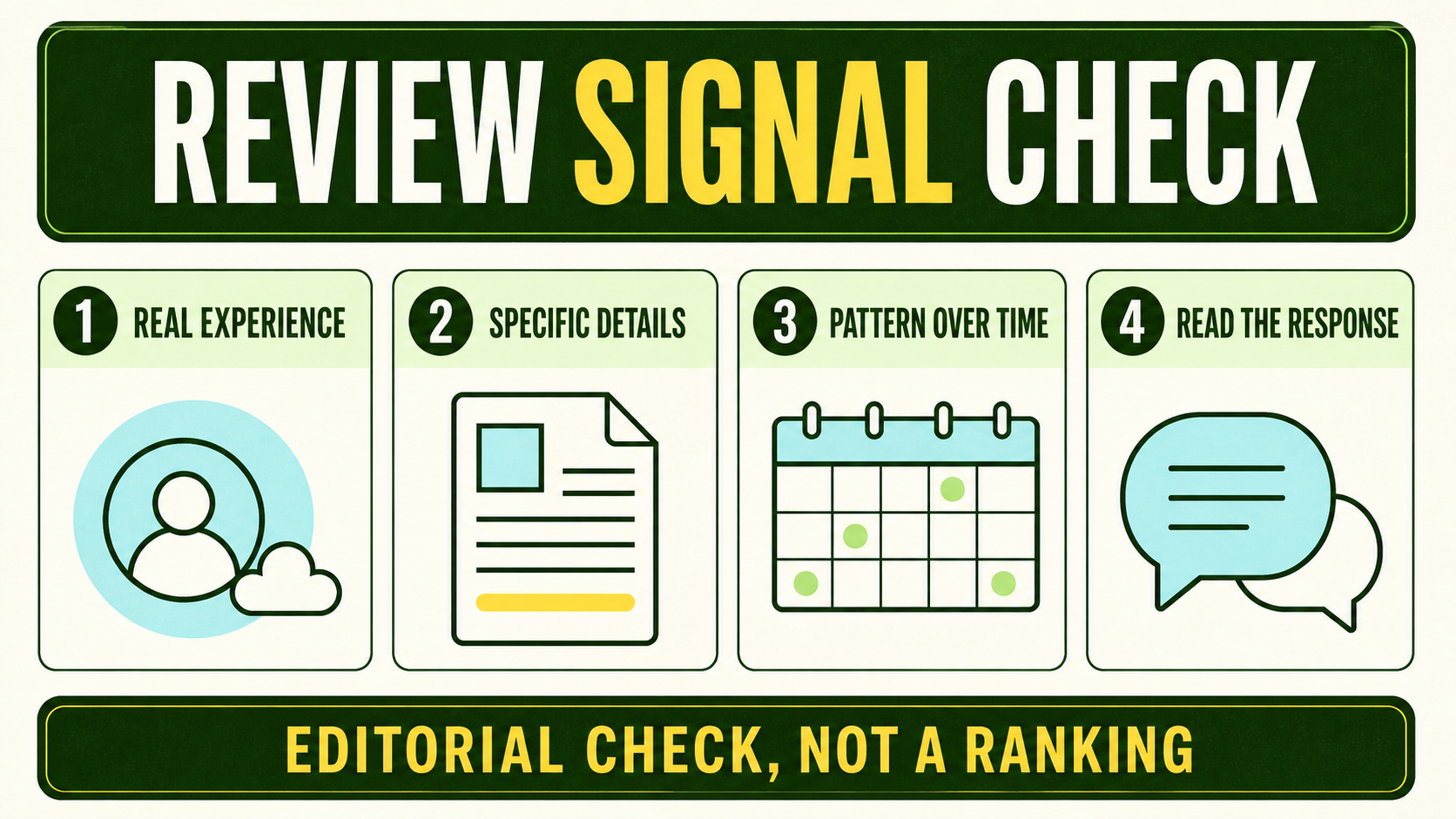
The four-signal review method
1. Look for a genuine experience
Google’s policy says a review should reflect an actual experience and be genuine and unbiased. A useful review gives enough context to show that the writer interacted with the provider. The context can mention the purpose, the type of contact, the report process or a concrete moment without exposing private documents.
A one-line “excellent service” rating gives little context. It is a positive data point, while the reason for the rating remains unknown. The same rule applies to a one-line complaint. Record what the review actually describes before you infer a conclusion.
2. Check for specific details
Specific details are more useful than a pile of adjectives. Look for observations about:
- whether the provider explained the assignment and required documents;
- whether the agreed appointment or delivery window was clear;
- whether the report explained its evidence and limitations;
- whether questions received a useful reply; and
- whether the experience relates to the property and report purpose you have.
Specificity does not prove that every fact is correct. It gives you something that can be checked in a quote or conversation.
3. Look for a pattern over time
Read multiple reviews across more than one date when possible. Note whether the same strength or weakness appears in different assignments and whether the provider’s current details match the review platform’s listing. A cluster of identical phrases, sudden bursts or reviews that discuss a different business can justify closer checking.
Do not treat review volume as a universal benchmark. A small specialist may have fewer reviews than a large platform and still be suitable. A large count may reflect a wider service mix that does not match your purpose.
4. Read the response, including the difficult ones
A response can show whether the provider answers a concrete concern, protects a client’s privacy and explains a next step. It cannot prove that the provider was right in the underlying dispute. Google says a negative review is not automatically a policy violation and should not be reported simply because the business dislikes it.
Look for a calm response that stays within verifiable facts. A reply that discloses private information, attacks the reviewer or promises to change a valuation can create a new question about professional judgment.
A transparent note sheet for comparing providers
For your own notes, score each provider from 0 to 2 on the four signals:
- 0: the signal is absent or raises a clear question;
- 1: the signal is partly present, but you need to verify it; and
- 2: the review set gives a specific, relevant and consistent signal.
The maximum is 8. This is an editorial conversation aid, not a rating of the appraiser or an industry benchmark. A provider with 8 out of 8 still needs a purpose, independence and recipient check. A provider with a low review note may deserve a call if the evidence is thin rather than negative.
The useful output is the question behind the note: “Can you explain how you handle this part of my assignment?” Asking each provider for the same scope makes valuation quote comparison meaningful.
Three examples
A detailed positive review
The reviewer explains that the provider clarified the mortgage purpose, gave a document list, arrived when agreed and explained the report’s comparable sales. That is evidence about process. Ask whether the current quote includes the same report scope and what validation the lender requires.
A high rating with no details
The rating may indicate satisfaction, while it tells you little about independence, report acceptance or a special property. Keep it as a weak signal and look for details elsewhere. Do not fill the gaps with assumptions.
Several complaints about timing
Repeated timing complaints can be useful when they describe dates, promises and outcomes. Ask for a realistic delivery window and the handoff point for validation. A complaint does not prove that the provider will miss your deadline, but it gives the deadline conversation a concrete focus.
Review traps and how to handle them
Treating the average as a guarantee
An average compresses different purposes, people and dates into one number. Use it as a screening clue, then read individual reviews and ask assignment-specific questions.
Assuming a missing review is a negative signal
Google says reviews can be delayed or removed for policy reasons. Missing content has several possible explanations. It does not prove that the provider had no satisfied clients or that a complaint was hidden.
Confusing a platform listing with professional registration
A business profile helps people find a provider. NRVT registration and the relevant report conditions answer different questions. Comparing property valuers puts provider answers beside the separate register information.
Treating a response as a verdict
A polished response is a communication signal, not an independent finding about the dispute. Compare the response with the review’s specific facts and with what the provider tells you directly.
What to ask after reading the reviews
Take these questions into a call or quote request:
- Who will sign the report, and can I verify the required registration?
- Have you or your firm worked on this property or for another party in the transaction?
- Which report and validation method fits my recipient?
- What is included in the delivery timing, including any validation step?
- Which documents would make the assignment easier to assess?
That sequence turns public commentary into a useful brief. A low quote or rushed decision should be tested against common selection mistakes before it is accepted.
Balanced evaluation
Reviews have selection bias. People with an unusually good or bad experience may be more likely to post, and platforms may remove content under their policies. A small provider may have little public review history. A large provider may have reviews for services that are different from the report you need.
Those limits do not make reviews useless. They define their proper role: reviews help you form questions about experience and communication. Professional status, independence, report scope, recipient acceptance and evidence remain separate checks. Use the whole chain before choosing.
Before the appointment, settle the practical questions that affect the report.
FAQ
Is a five-star average enough to choose an appraiser?
No. It can be an initial signal about public satisfaction, while it cannot confirm independence, report acceptance, scope or current timing for your assignment.
Should I ignore a negative review?
No. Read the facts, date and response. A negative review can reveal a question about timing or communication, while it does not automatically prove poor professional work.
Can paid reviews be trusted?
Treat them as a serious warning. Google’s policy prohibits paid or incentivized review activity and says reviews should reflect genuine, unbiased experiences.
What if a review has disappeared?
Do not infer one reason. Google says reviews may be delayed or removed for policy reasons. Check the current listing and ask the provider direct questions.
A review can show how someone experienced communication or timing, while the report's purpose, independence and recipient rules still need direct checking. Save two or three useful examples and ask the provider how the same points would be handled for your assignment. Contact us if you want help turning review signals into a provider checklist.
Ask about reading appraiser reviews →