Top 10 Mistakes in Holiday Home Valuation
The ten valuation mistakes that can distort a holiday home appraisal, from use rights and rental evidence to condition, costs and value purpose.

A holiday home needs its own evidence
If you own, buy, finance or advise on a holiday home, check its use rights, park terms, rental evidence, seasonality and value date before you rely on a valuation.
Those facts create a different evidence pattern from an ordinary home, so each mistake can move the report away from the question you need answered.
Table of contents
- TL;DR
- What makes a holiday home different
- How these checks were selected
- Fast answer
- Full list
- Comparison cards
- How to choose
- Frequently asked questions
TL;DR
Before ordering a holiday-home valuation, write down how the property may be used, rented and transferred. Then ask whether the evidence covers the park, season, services, restrictions and market that actually apply to the home.
- Confirm what use is permitted at the address.
- Separate owner use, rental income and operating costs.
- Define the fixed property and exclude movable items where needed.
- Match evidence to the park, location, season and value date.
- State the report recipient and value purpose before the work starts.
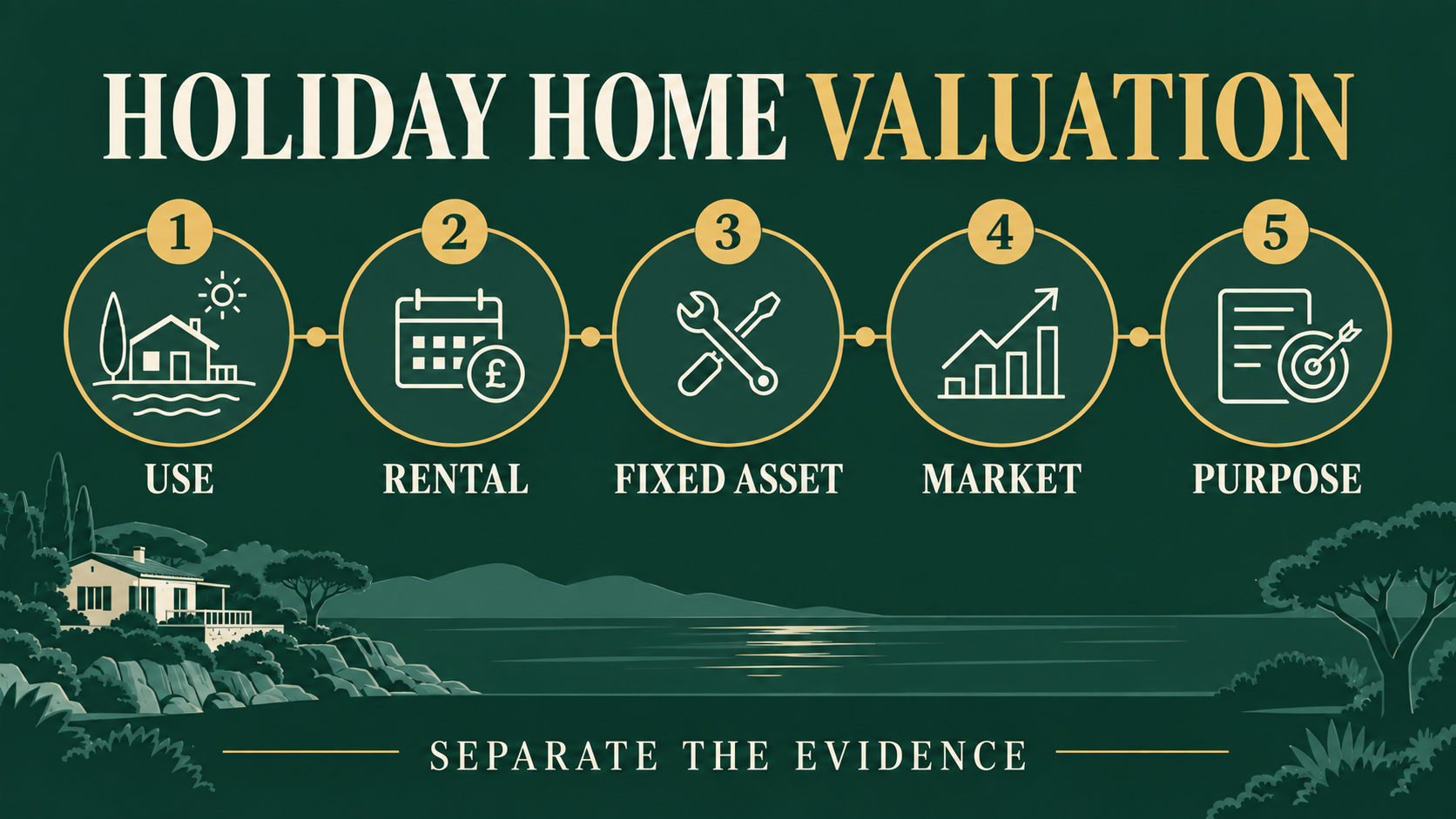
Once you name the decision, the rest of the valuation becomes easier to follow.
If you are assessing a holiday home near Eindhoven, consider a property valuation in Luyksgestel as residential evidence, then analyse park rules, rental use and personal use separately.
What makes a holiday home different
A holiday home may be a building on owned land, a leasehold unit, a right within a park or a property with shared roads and facilities. The legal position, park rules, rental contract and local plan can affect the interest that a report describes.
The holiday-home valuation topics group related property and purpose questions.
The wider holiday-home valuation topic keeps use, park terms and rental evidence together.
Rental records need the same care. Gross bookings can hide commission, cleaning, energy, management, maintenance, tax and empty weeks. Owner stays reduce the number of nights available for guests. A national accommodation statistic can show seasonality while saying little about one unit.
The valuation question matters at the start. Market value for sale, value for finance, a tax value and a value for division each bring their own recipient, date and assumptions.
These are the details worth checking before you compare providers or send the file.
The records needed for a holiday-home valuation bring park terms, ownership records and condition notes together.
How these checks were selected
The question it answers
Which ten mistakes can distort a holiday-home valuation in 2026? The list tests legal use, rental operation, fixed property, market evidence and purpose. It does not decide the planning position of a particular park.
What each item covers
Each mistake was checked against:
- documented use and residence rules;
- rental terms, income periods and costs;
- building, land, fixtures and movable contents;
- location, park and comparable evidence;
- property interest, value date and recipient.
Evidence behind the selection
The analysis combines public Rijksoverheid information on recreation-home residence, CBS accommodation statistics and NRVT guidance on rural property scope and uncertainty. The result is a pre-appointment review order that keeps one attractive number from controlling the whole file.
Market value and WOZ value answer different questions, so the holiday-home brief needs one stated purpose.
When the checks need revisiting
Local plans, permits, park contracts and policy can change. CBS values for 2026 are provisional. Recheck address-specific use, contract terms, records and recipient conditions when the assignment changes, and review these checks yearly.
That first comparison gives the rest of the discussion a clear shape.
Fast answer
Quick recommendation cards
- Review use first: the owner, buyer or lender is unsure whether the stated recreation or residence use is permitted.
- Review rental evidence first: the price discussion relies on gross bookings, a single season or a park brochure.
- Review the report brief first: the requested value, date, property boundary or recipient is unclear.
The order matters because a rental forecast cannot repair an undefined property interest or an unsupported use assumption.
After the evidence list is clear, valuation quote comparison puts rental research, inspection and fee beside one another.
Full list
1. Treating the unit as an ordinary home
A recreation home can have park rules, shared land, rental obligations and a different buyer group. Residential comparables may miss those rights and restrictions.
Why it matters: the evidence needs park-specific transactions, contracts, facilities and use conditions.
Ask yourself: Which rights and restrictions make the subject comparable to the selected sales?
2. Assuming permanent residence is allowed
Residence rules depend on the local plan and the address-specific position. A buyer’s intention does not create a right to live there permanently.
Why it matters: the report needs a dated assumption about use, with a clear boundary between valuation and the authority’s decision.
Ask yourself: Which document supports the stated use, and who confirms the current rule?
3. Mixing owner use with rental performance
Owner stays reduce rentable nights and may reflect a different quality of use from guest bookings. A calendar with blocked weeks needs a separate reading from paid reservations.
Why it matters: occupancy, available nights and owner use should be shown as separate lines.
Ask yourself: Which period and which nights form the rental evidence?
4. Using gross bookings as property income
Gross booking revenue may include cleaning, commissions, energy, management and taxes that never become property income. A report needs a consistent net view and a stated treatment of costs.
Why it matters: the operating evidence becomes comparable with the selected method and the property boundary.
Ask yourself: Which costs are deducted, and which belong to the business or operator?
5. Relying on one strong season
Weather, events, reviews, price changes and a new park facility can lift a single season. One period rarely shows the full pattern.
Why it matters: the file should cover several periods where available and explain missing or unusual data.
Ask yourself: Which years, months or booking channels support the rental conclusion?
6. Overlooking park, VvE or service rights
Ground lease, shared roads, maintenance charges, rental pools, service fees and resort rules can affect use and cash flow. The brochure is not the same as the signed contract.
Why it matters: contracts, budgets, rules and notices become part of the property evidence.
Ask yourself: Which signed terms and recurring charges were included?
7. Counting furniture as real estate
Beds, televisions, loose kitchens, garden items and other movable contents can sit close to the building in a listing. They may need a separate value treatment.
Why it matters: the report should state which fixtures and contents form part of the interest.
Ask yourself: Which items remain with the property, and how are they treated?
8. Ignoring access, facilities and location
A park’s roads, water access, recreation facilities, parking, noise and nearby attractions affect buyer demand. A distant comparable can look similar in size and still answer a different market.
Why it matters: local and park evidence must explain the reasons for differences.
Ask yourself: Which location and facility facts distinguish the selected comparables?
9. Treating a future change as a current right
A plan to convert, extend, rent differently or live permanently in the unit is a scenario until the required permission and contract position are known.
Why it matters: current value and future scenario need separate assumptions and sensitivity.
Ask yourself: Which part of the value rests on a confirmed right and which part rests on a plan?
10. Leaving purpose and date open
A report for a sale, lender, tax question or division can need a different value basis, date and recipient. An old report may answer yesterday’s question.
Why it matters: the instruction, evidence and report wording become specific.
Ask yourself: What value is required, at which date, for whom and for which decision?
Comparison cards
- Use: permitted recreation, residence, rental and future scenarios. Your brief states the address-specific evidence.
- Rental: bookings, owner stays, costs, seasonality and contract terms. Your brief separates gross receipts from property income.
- Fixed asset: land, building, fixtures, shared facilities and movable contents. Your brief sets the boundary.
- Market: park, location, access, facilities, condition and comparable sales. Your brief explains adjustments.
- Purpose: sale, finance, tax, division or another question. Your brief names recipient, date and value basis.
The cards help a client find the first weak evidence block. A full booking spreadsheet cannot fill a missing residence rule, and a park rule cannot establish market value by itself.
How to choose
- Collect the legal facts. Save the local plan result, permits, park rules, lease or ownership records.
- Build the rental period. Separate owner stays, paid nights, cancellations, costs and channels.
- Draw the property boundary. List land, building, fixtures, furniture, shared facilities and service charges.
- State the valuation question. Name purpose, value date, interest and recipient.
- Compare the work. Ask each candidate for the same inspection, records, method, assumptions, timing and fee.
Frequently asked questions
Can I live permanently in a holiday home?
The answer depends on the local plan, permission and the address. A valuation can record the use assumption; the municipality or other competent authority decides what is allowed.
Should rental income be used in every holiday-home valuation?
Rental history can help when the property is traded or operated through letting. Owner use, costs, contract restrictions and the chosen value purpose decide how the figures belong in the analysis.
Are furniture and appliances included?
Your assignment should state the property boundary. Fixed fixtures may be treated differently from movable contents, so list them before the inspection.
Does a park contract affect value?
It can affect rent, use, service charges, resale and access. The signed terms and current charges matter more than a general brochure.
Can a future residence plan raise value today?
A future plan needs a documented assumption about policy, permission and timing. Current value and a possible future scenario should remain separate in the report.
When is a second opinion useful?
A second opinion can help when the report relies on one season, unclear costs, an unsupported use assumption or weak comparables. Give the second appraiser the same records and name the question under review.
Write down the park rules, permitted use, ownership or lease, rental agreement, booking history, service costs, condition and value purpose before requesting a holiday-home valuation. Ask which fixtures, furniture and operating figures belong in the property scope. Contact us when the holiday-home evidence needs to become a clear valuation brief. Do not send passports, contracts, bank details or other personal documents through the public form.
Ask about holiday-home valuation →