Appraiser for Buying a Home: What Buyers Should Check
A practical guide to choosing a property appraiser for a home purchase, from lender requirements and independence to documents, timing and report use.

When this valuation matters
If you are buying a home, connect the agreed price, mortgage decision and the home’s condition in the valuation brief. Buyers, advisers and lenders can set the assignment before a deadline turns an open question into a costly delay.
Table of contents
- TL;DR
- What an appraiser does for a purchase
- Why the report purpose matters
- The buyer’s main checks
- A purchase valuation path
- Common mistakes and edge cases
- FAQ
TL;DR
When you are buying a home, give the appraiser the purchase details, lender requirements and any work or legal issue that could affect value. The report supports a stated decision and date; it does not replace a building survey, legal review or mortgage assessment.
For an NHG physical valuation, NHG currently requires an independent maker, validation by an accepted validation institute and a report no older than six months from the value date. The condition is specific to the NHG context. Confirm the current rules for your lender before ordering.
Before you order, compare NHG valuation requirements with your lender’s current report type, inspection and validation instructions.
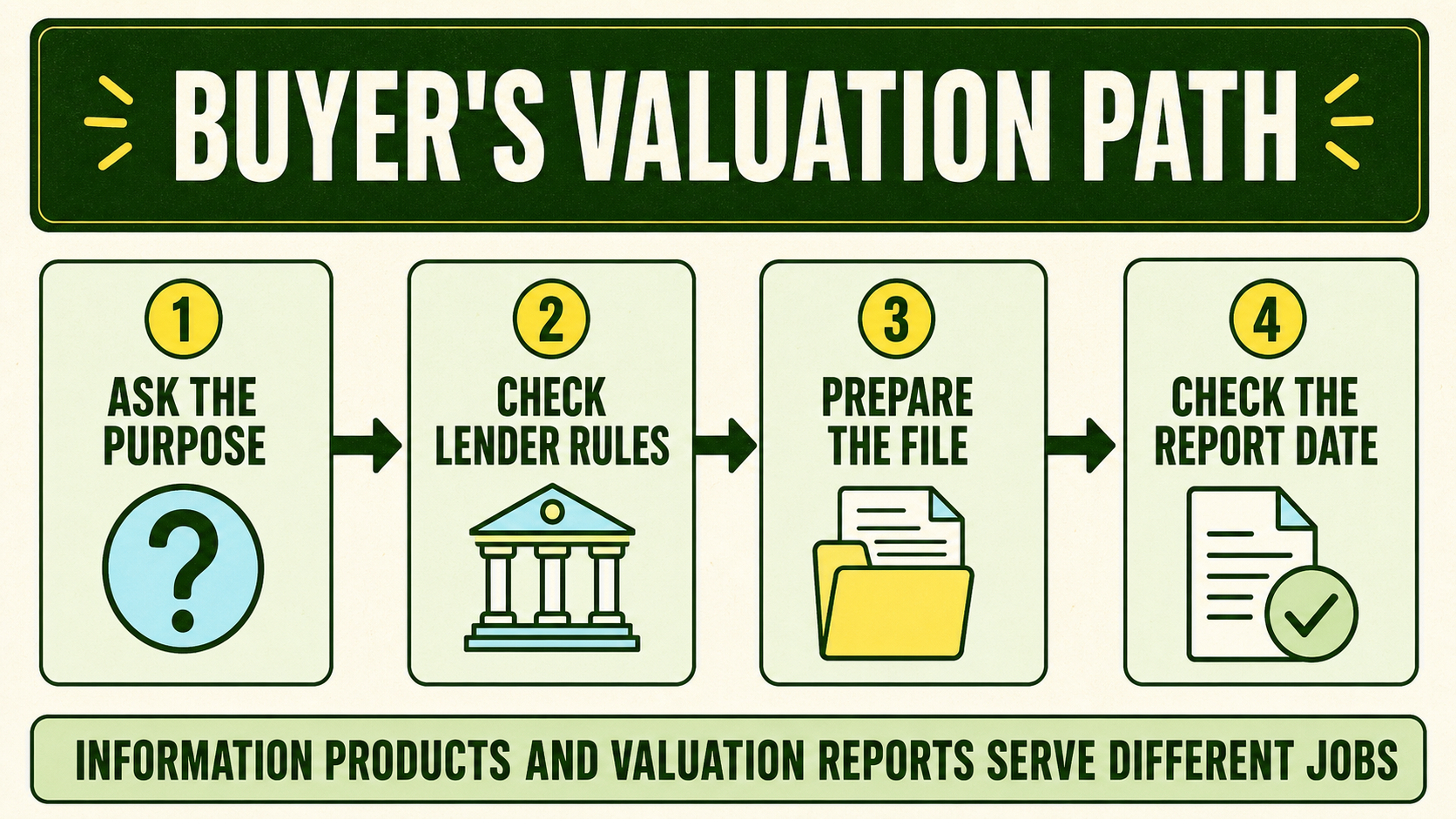
Once you name the decision, the rest of the valuation becomes easier to follow.
A buyer comparing providers should match property valuation evidence from Valkenswaard to the lender’s method, value date and recipient requirements before choosing a report.
What an appraiser does for a purchase
A property appraiser forms and reports an opinion of value for a stated purpose and value date. The work can include an inspection, property and title information, comparable sales, planning and leasehold research, condition observations and a written explanation of the conclusion. The exact scope comes from the assignment and recipient.
A buyer’s agent has a different task. An agent can advise on the transaction, negotiation and purchase terms. An appraiser supplies value evidence. A purchase can need both, because deciding whether to bid and proving value for financing are separate decisions. A buyer also needs purchase preparation to connect the offer, lender requirement and property file.
Here is why the distinction matters when you are arranging the report.
Why the report purpose matters
Say who will use the report:
- Mortgage: the lender may require a named report model, registration, validation method and current value date.
- Offer or negotiation: a buyer may want independent evidence before deciding how much to bid, while the recipient may not require a lender report.
- Renovation or construction finance: the report may need current value, planned work and value after improvement.
- Legal or ownership question: the assignment may need a different value date, definition or recipient.
Timing changes with the purpose: mortgage valuation timing follows lender conditions, while purchase valuation timing follows the buyer’s decision. Keeping the intents separate helps prevent a general estimate from being offered as the solution to a lender requirement.
These are the details worth checking before you compare providers or send the file.
The buyer’s main checks
Purpose and recipient
Write the decision and recipient in one sentence. “I need a valuation for my mortgage application with lender X” gives a provider something testable. “I need to know what the home is worth” leaves method, date and use open.
Independence
Ask whether the appraiser or firm has advised, sold, brokered, inspected, managed or valued the property before. Also ask about relationships with the buyer, seller, broker and lender. Prior involvement and pressure make appraiser independence and conflicts of interest a question to settle before appointment.
Registration and validation
NRVT records Register-Taxateurs personally. Check the register when the recipient requires that status. Validation is a separate step. NWWI describes validation as checking a report from an affiliated appraiser against uniform requirements; the lender or recipient still determines whether that method fits the case. Before treating a logo or platform name as the whole acceptance check, confirm what NWWI validation means and ask whether the recipient accepts that method.
Evidence and value date
The appraiser needs a usable property file. The value date tells you when the reported opinion applies. A report’s age can be measured from that date under a recipient’s rules. A report’s age is meaningful only alongside purpose and recipient, so valuation report validity must be assessed against the current file.
A purchase valuation path
1. Ask the purpose
Confirm whether you need a lender report, a purchase decision aid or another valuation. Record the recipient and any written requirements. If the lender has a mortgage adviser or portal instruction, save that information with the brief.
2. Check lender rules
Ask about the required report type, appraiser status, inspection method, validation institute, value date and age limit. NHG’s physical-report conditions illustrate one lender context. Your lender’s current instructions decide the report you need.
3. Prepare the property file
Gather the purchase agreement or relevant offer information, floor plans, permits, leasehold details, homeowners’ association documents where relevant, energy evidence, invoices and information about known defects or planned work. Label dates and identify missing items. A complete file needs property valuation documents that show what the appraiser still needs.
4. Compare the provider scope
Ask each provider to state who signs, what is inspected, which report is produced, whether validation is included, which documents are needed and when the final report is delivered. Compare the same work. Matching those fields is the basis of valuation quote comparison.
5. Check the report date after delivery
Confirm the value date, report date, recipient and validation status. Send the report through the lender’s requested channel. If the lender requests a correction or more evidence, ask the appraiser which part of the file or report needs attention rather than changing the value to fit a target.
Information products versus a valuation report
Kadaster says its Koopsominformatie, Woningrapport and related products can help a buyer estimate a home’s value. The same guidance says that an exact current value requires a valuation by a broker or appraiser. The products answer useful research questions, while a lender’s report answers a formal recipient question.
On 31 August 2026, the Kadaster pages listed Koopsominformatie at €3.70 and a Woningrapport at €21.50. These are the displayed product prices recorded at retrieval, not an appraiser fee and not a promise that the pages will show the exact current price later. Check the live product page before ordering.
That price comparison can be useful for early research. It does not turn a €3.70 or €21.50 information product into a validated mortgage report. Statutory and market values answer different questions, so market value and WOZ value should stay separate in the brief.
Small shortcuts can change the report even when the property itself has not changed. Keep these traps in view.
Common mistakes and edge cases
Online estimate used for a lender report
An online method can be suitable for an early estimate or a recipient that explicitly accepts it. Ask who may rely on the output and what evidence it contains. The choice between online and physical valuation should follow the recipient’s accepted evidence, not speed alone.
Report ordered after the deadline is already fixed
Work backwards from the lender’s submission cutoff. Include inspection, document follow-up, report writing, validation and correction time. A lender deadline becomes manageable when appraiser selection under a tight deadline separates those checkpoints.
Leasehold, apartment or special property
Describe leasehold terms, homeowners’ association issues, monument status, split ownership, rental use, construction or other unusual facts at the first contact. They can change the evidence and specialist knowledge required.
Planned renovation
Separate current value from value after improvement. Ask whether the report needs budgets, plans, permits or a post-work scenario. A quote for current value alone cannot be compared with a quote that includes a future-value analysis.
A low valuation after the purchase agreement
The report records an independent opinion under its stated assumptions. Ask the lender, adviser and appraiser which options remain, such as additional evidence, a review or a different financing structure. A request to raise the number without supporting evidence undermines the report’s purpose.
Before the appointment, settle the practical questions that affect the report.
FAQ
When should a buyer order a property valuation?
As soon as the report purpose, recipient and deadline are known. A mortgage application may require the report after an offer or purchase agreement, while the lender’s own process controls the exact timing.
Does every buyer need an appraiser?
No single answer applies to every purchase. A lender or other recipient may require a report, while a buyer may also order independent evidence for a bid or risk decision. Confirm the purpose before ordering.
Does an NRVT registration guarantee acceptance?
No. Registration addresses professional status. The report method, recipient, validation and date conditions remain separate checks.
Can Kadaster information replace an appraisal?
It can help with early price research. Kadaster distinguishes those information products from a current valuation by a broker or appraiser. Follow the recipient’s rule for a formal report.
How long can a purchase valuation be used?
There is no universal answer for all recipients. NHG’s current physical-report example uses a six-month limit from the value date. Check the current lender or recipient condition for your case.
A buyer can collect useful sale-price information before ordering a report, but the lender or other recipient decides what output is acceptable. Ask for the current report, validation and date conditions, then send the appraiser a brief that matches them. Contact us if you want to check the questions for your purchase.
Ask about a purchase valuation →